
The Janka wood hardness scale measures how well solid wood resists dents and surface wear. A higher rating means the wood requires more force to indent.
For cabinet shops and woodworking professionals, a high Janka rating can improve durability. It can also increase machining time, tool wear, finishing requirements, and material cost. The best wood is not always the hardest wood.
Woodworkers also rarely choose a species based on hardness alone. Walnut, for example, is often selected for its color and grain. Its moderate hardness is an added benefit.
Choose a species that balances appearance, durability, stability, machinability, finishing needs, availability, and price.
Quick Skim: Understanding the Janka Scale
| Decision factor | What woodworkers should know |
|---|---|
| What the Janka rating measures | Resistance to indentation |
| How ratings work | Higher numbers indicate harder wood |
| Common U.S. unit | Pounds-force, shown as lbf |
| Lower-rated wood | Easier to machine but more likely to dent |
| Higher-rated wood | Better dent resistance but often harder on tooling |
| Common cabinet species range | Many popular species fall between 950 and 1,450 lbf |
| Extremely hard species | Ebony, mesquite, and bubinga can exceed common cabinet woods |
| Stain absorption | Dense hardwoods may need a deep penetrating stain or dye system |
| Custom stain matching | Use an approved control sample made from the production species |
| Surface protection | The finish often provides more daily protection than the wood’s Janka rating |
| Species consistency | Visible millwork usually uses one species for uniform color and grain |
| What the rating does not measure | Stability, strength, screw holding, moisture resistance, grain, stain response, or finish performance |
| Best buying approach | Match the species and finish system to the application and shop process |
What Is the Janka Wood Hardness Scale?
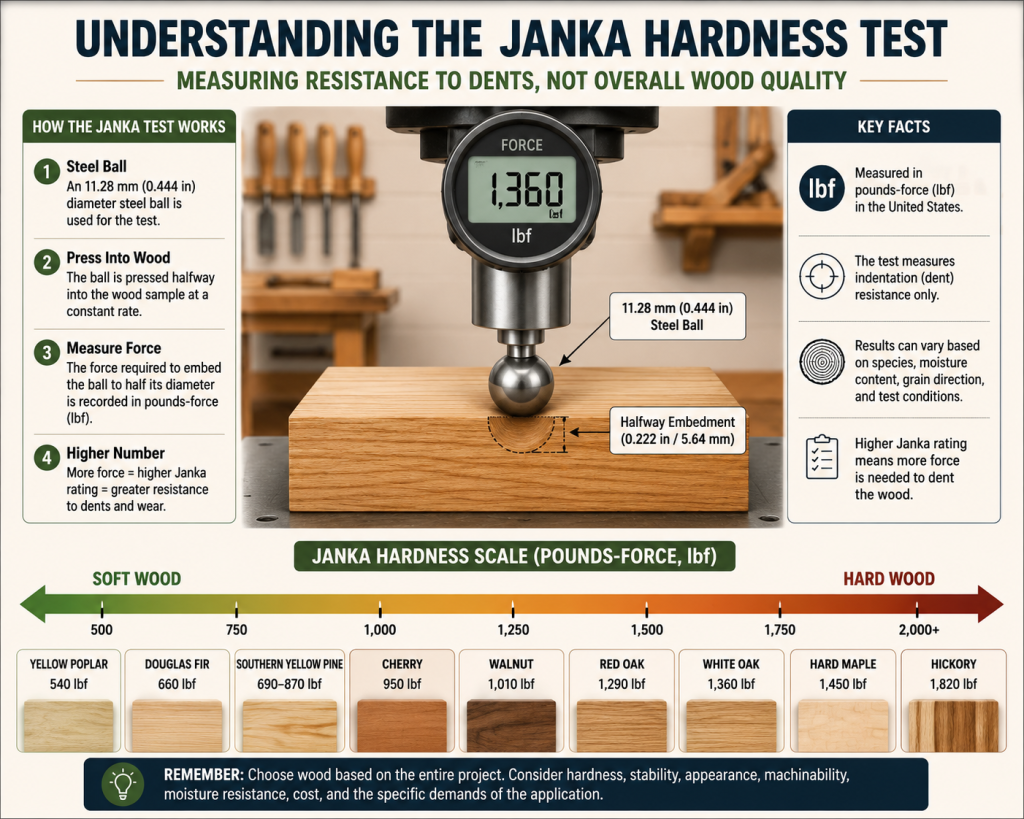
The Janka test measures the force needed to press an 11.28 mm, or 0.444-inch, steel ball halfway into a wood sample. U.S. ratings usually appear in pounds-force.
For example, a Janka rating of 1,360 lbf means the test required 1,360 pounds of force to embed the ball to the specified depth.
ASTM D143 includes hardness testing procedures for small, clear wood specimens. It controls factors such as sample size, moisture content, temperature, and loading rate so testers can compare results more consistently.
A Higher Janka Rating Does Not Always Mean Better Wood
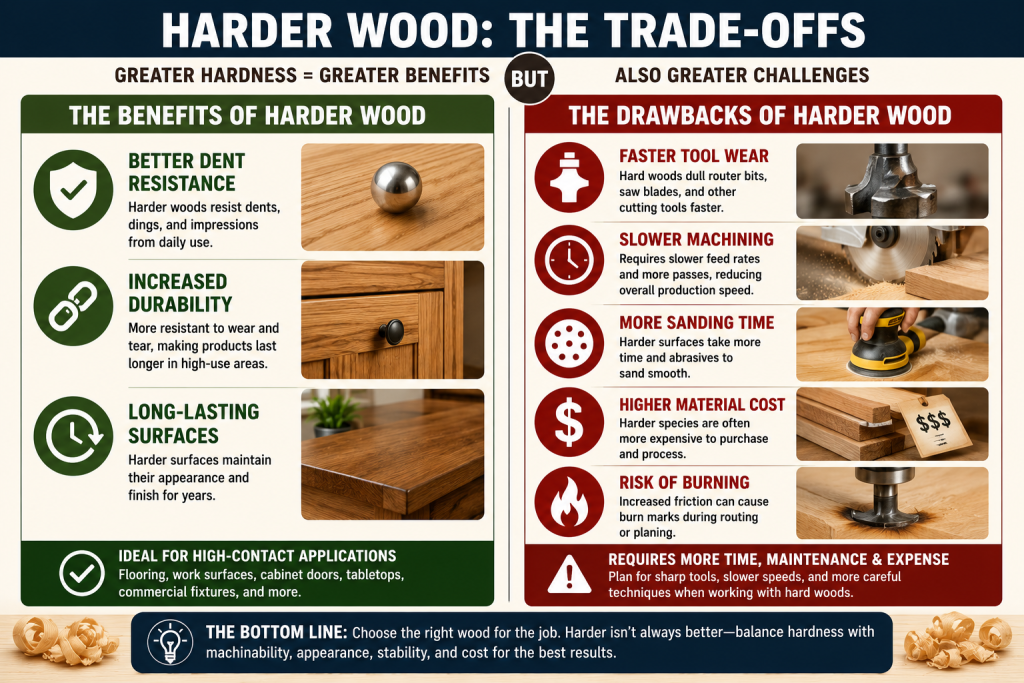
A higher number usually means better resistance to dents. That can help on flooring, work surfaces, commercial fixtures, cabinet doors, and other parts that receive frequent contact.
However, very hard wood may:
- Dull cutters and sanding abrasives faster
- Require slower or more controlled machining
- Increase the risk of burning during routing
- Need pilot holes for some fasteners
- Resist stain penetration
- Cost more than a softer alternative
A lower-rated species may offer a better balance for painted millwork, decorative components, mouldings, cabinet interiors, and lightly used furniture.
A durable finish can also improve the performance of softer wood. In many applications, the finish system provides more protection against scratches, moisture, chemicals, and daily handling than the Janka rating alone.
Janka Hardness Chart for Common Wood Species
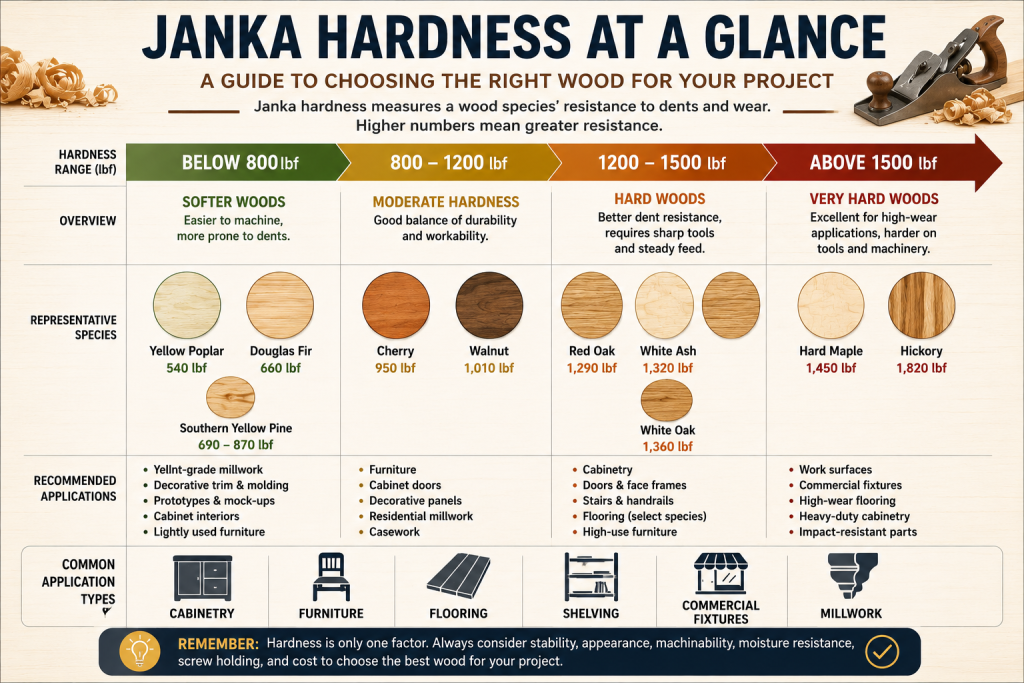
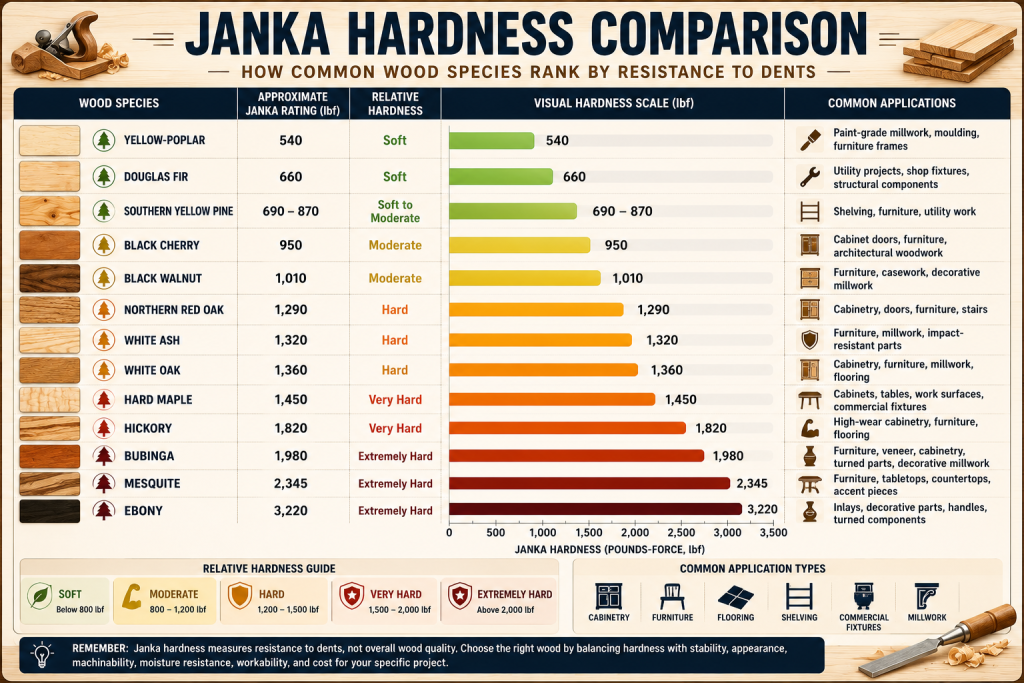
The following ratings provide a practical comparison of species often used in cabinetry, furniture, millwork, and general woodworking.
| Wood species | Approximate Janka rating | Relative hardness | Common applications |
|---|---|---|---|
| Yellow-poplar | 540 lbf | Soft | Paint-grade millwork, moulding, furniture frames |
| Douglas fir | 660 lbf | Soft | Utility projects, shop fixtures, structural components |
| Southern yellow pine | 690 to 870 lbf | Soft to moderate | Shelving, furniture, utility work |
| Black cherry | 950 lbf | Moderate | Cabinet doors, furniture, architectural woodwork |
| Black walnut | 1,010 lbf | Moderate | Furniture, casework, decorative millwork |
| Northern red oak | 1,290 lbf | Hard | Cabinetry, doors, furniture, stairs |
| White ash | 1,320 lbf | Hard | Furniture, millwork, impact-resistant parts |
| White oak | 1,360 lbf | Hard | Cabinetry, furniture, millwork, flooring |
| Hard maple | 1,450 lbf | Very hard | Cabinets, tables, work surfaces, commercial fixtures |
| Hickory | 1,820 lbf | Very hard | High-wear cabinetry, furniture, flooring |
| Bubinga | 1,980 lbf | Extremely hard | Furniture, veneer, cabinetry, turned parts, decorative millwork |
| Mesquite | 2,345 lbf | Extremely hard | Furniture, tabletops, countertops, accent pieces |
| Ebony | 3,220 lbf | Extremely hard | Inlays, decorative parts, handles, turned components |
These figures represent common reference values, not guaranteed ratings for every board. Published numbers can differ due to moisture, growing conditions, exact species, sample selection, and test procedures.
How to Read Janka Hardness Ratings
The following ranges offer a useful shop guide. They are not official grades.
Below 800 lbf: Softer Woods
Softer woods cut and shape with less effort. They work well for paint-grade millwork, decorative trim, prototypes, and parts that receive limited contact.
They can also dent during production, shipping, installation, or daily use. Handle finished components carefully and use protective packaging.
Examples include yellow-poplar and many softwoods.
800 to 1,200 lbf: Moderate Hardness
This range offers a strong balance between machining and dent resistance. It works well for furniture, cabinet doors, decorative panels, and residential millwork.
Cherry and walnut fall within this general range. Both machine well and offer strong visual appeal, though they remain softer than oak or hard maple.
Walnut is a good example of why appearance often drives species selection. Shops usually choose it for its color, grain, and premium look. Its moderate hardness supports the application, but it is rarely the main reason for specifying walnut.
1,200 to 1,500 lbf: Hard Woods
Wood in this range provides better resistance to everyday dents. It is common in cabinet doors, face frames, furniture, stairs, and commercial interiors.
Red oak, white oak, white ash, and hard maple fall within or near this range. Shops should use sharp cutters and maintain a steady feed rate to limit burning and tear-out.
Above 1,500 lbf: Very Hard Woods
Very hard woods suit high-contact applications. Hickory, bubinga, mesquite, and ebony are examples.
These species can extend product life in demanding environments. They can also slow production and increase tooling and finishing costs. Confirm that the extra hardness provides real value before specifying one for a project.
In visible millwork, shops usually do not mix species simply to place harder wood in high-wear areas. Most projects use one primary species to maintain uniform color, grain, texture, and stain response.
Why Janka Ratings Can Vary
Wood is a natural material. Two boards from the same species may not perform exactly the same.
Several factors affect hardness.
Moisture Content
Wood generally becomes harder as it dries below the fiber saturation point. A rating taken from dry wood may be higher than a rating taken from green wood.
Compare ratings measured at similar moisture levels whenever possible.
Exact Species
Common names can describe more than one species. Southern yellow pine, maple, oak, hickory, ebony, mesquite, and bubinga can each include woods with different physical properties.
Verify the botanical or commercial species when hardness is critical.
Growing Conditions
Soil, climate, growth rate, location within the tree, and available growing space can affect density and mechanical properties.
Grain Direction
Wood has different properties along its longitudinal, radial, and tangential axes. Janka charts often show side hardness, which measures resistance on the face or edge rather than the end grain.
Testing Method
Specimen size, conditioning, temperature, moisture level, and loading rate can affect results. Compare values from similar test methods whenever possible.
What the Janka Scale Does Not Tell You
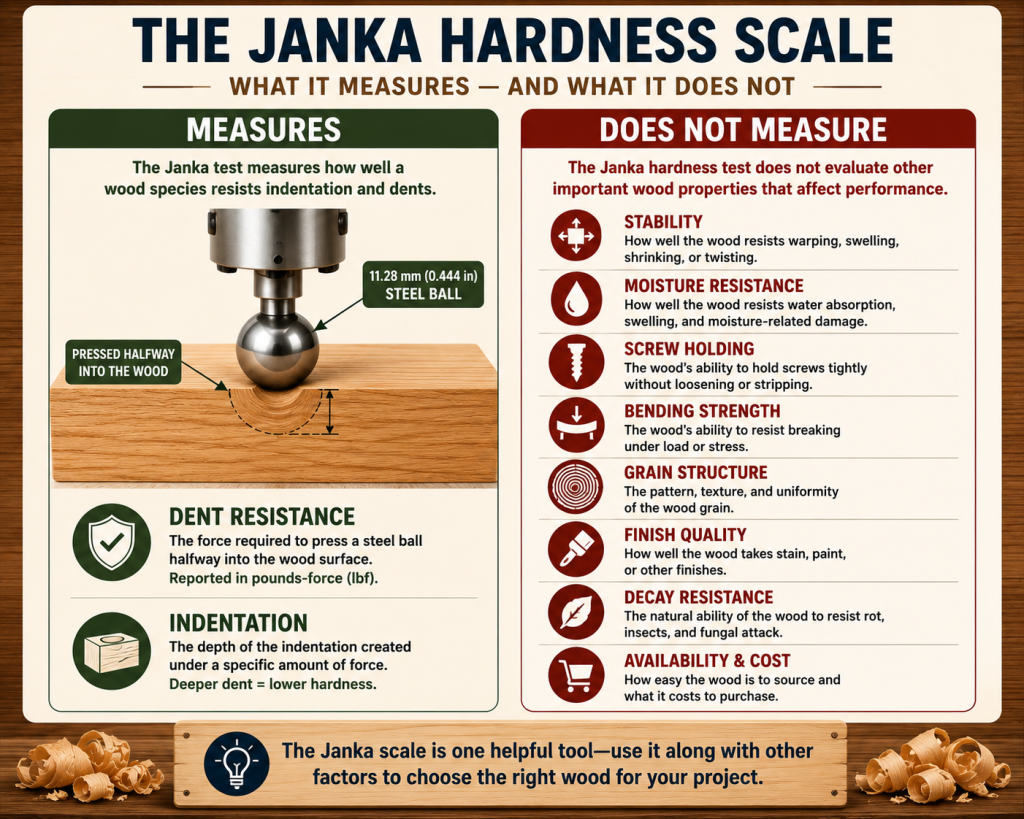
The Janka rating measures indentation resistance. It does not provide a complete performance profile.
| Property | Why it matters |
|---|---|
| Dimensional stability | Determines how much a part may expand, shrink, cup, or warp |
| Bending strength | Affects shelves, frames, rails, and load-bearing components |
| Stiffness | Helps control sag and deflection |
| Screw holding | Influences hardware installation and long-term joint performance |
| Moisture resistance | Matters in kitchens, bathrooms, and other damp locations |
| Decay resistance | Affects outdoor and exposed applications |
| Grain structure | Changes machining, filling, staining, and finishing requirements |
| Stain response | Affects color depth, clarity, and uniformity |
| Adhesive performance | Affects assembly methods and production reliability |
| Finish performance | Helps determine resistance to scratches, abrasion, moisture, and chemicals |
| Availability | Influences lead time, yield, and project cost |
A hard species can still move with moisture. It can also accept stain unevenly or need a different finishing process.
A softer species can still provide excellent long-term performance when the shop pairs it with the right construction and finish system.
Choosing Wood Hardness by Application
Cabinet Doors and Face Frames
Cabinet doors and face frames need enough hardness to resist routine handling. They must also machine cleanly and accept a consistent finish.
Cherry and walnut offer moderate hardness and strong visual appeal. Oak and hard maple provide greater dent resistance for kitchens, commercial spaces, and other active areas.
However, appearance often drives the decision. A shop may choose walnut for its color and grain, not because it is harder than other options. Its hardness is an added benefit.
Most visible millwork projects use one primary species. Keeping the species consistent helps maintain uniform:
- Natural color
- Grain pattern
- Texture
- Stain response
- Sheen
- Aging characteristics
Mixing visible species can make custom color matching difficult, even when the woods have similar Janka ratings.
For painted components, a softer and easier-to-machine species may offer better production value than a premium hard wood.
Cabinet Boxes and Shelving
Janka hardness has less value when selecting plywood, particleboard, or MDF for cabinet boxes. Core construction, panel thickness, face grade, screw holding, span, and moisture resistance have a greater effect on performance.
For veneered panels, the face species may influence surface wear. However, the substrate, veneer thickness, and finish system still play major roles.
Furniture and Tables
Consider how the finished piece will be used.
A side table may not need the hardness of maple, hickory, mesquite, or ebony. A dining table, retail counter, or work surface may benefit from a harder species and a durable finish.
Mesquite can provide strong dent resistance for a tabletop. Bubinga can add distinctive grain to premium furniture. Ebony often works best for small, intentional accents.
The shop should still maintain species consistency across visible parts unless the design specifically calls for contrast.
Also consider repair needs. A surface that can be sanded and refinished may provide more long-term value than hardness alone.
Moulding and Architectural Millwork
Machinability often matters more than maximum dent resistance for detailed profiles.
Very hard wood can produce durable trim, but it may increase cutter wear and machining time. Softer woods can run faster and produce clean profiles when tools remain sharp and grain direction stays consistent.
For visible architectural millwork, species selection usually starts with the required look. Color, grain, stain response, and project specifications often matter more than a small difference in Janka rating.
Commercial Fixtures
Retail, hospitality, healthcare, and office fixtures often receive repeated contact. Hard maple, white oak, mesquite, and other dense species can improve dent resistance.
However, shops usually specify one visible species throughout the project rather than mix woods based on hardness. When a softer species needs greater protection, a stronger finish system may provide a better solution than changing species.
Edge design, component thickness, joinery, substrate selection, and replaceable wear parts can also improve performance.
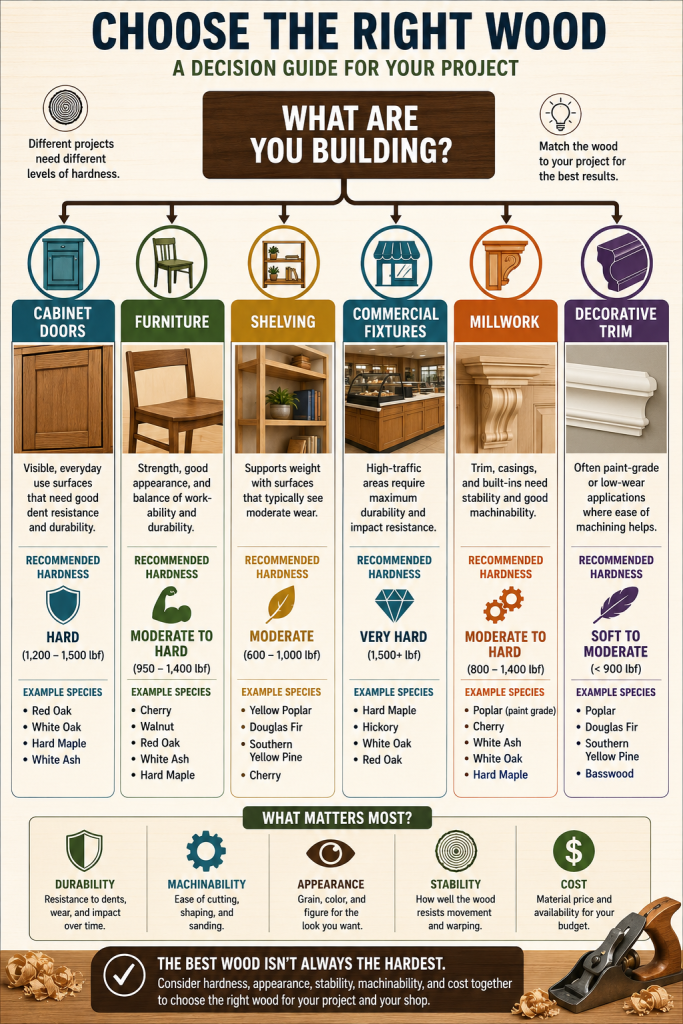
How Wood Hardness Affects Shop Workflow
Cutting and Routing
Harder woods place more demand on saw blades, router bits, shaper cutters, and CNC tooling. Keep cutting edges sharp and use the correct feed rate.
Too little feed can cause heat and burn marks. Too much feed can produce tear-out or poor edge quality.
Dense species such as ebony, mesquite, and bubinga may require test cuts before full production.
Sanding
Hard wood may take longer to level, especially after machining. Follow a consistent grit sequence and replace worn abrasives before they begin to polish instead of cut.
Soft wood requires control. Excess pressure can create low spots, rounded edges, or uneven stain absorption.
Sanding also affects the final stain color. A change in finishing grit can change how deeply the stain penetrates and how dark the wood appears.
Drilling and Fastening
Dense species may require pilot holes, especially near board ends and edges. Match the pilot size to the fastener and wood density to reduce splitting.
Do not assume that a high Janka rating guarantees better screw holding. Grain, density, fastener design, and installation method also affect the connection.
Finishing
Wood hardness can affect stain penetration and the final color.
Dense hardwoods may not absorb a standard wiping stain as deeply or evenly as softer, more porous woods. Some hard species may need a deep penetrating stain, often called DPS, or a compatible dye stain to reach the required color.
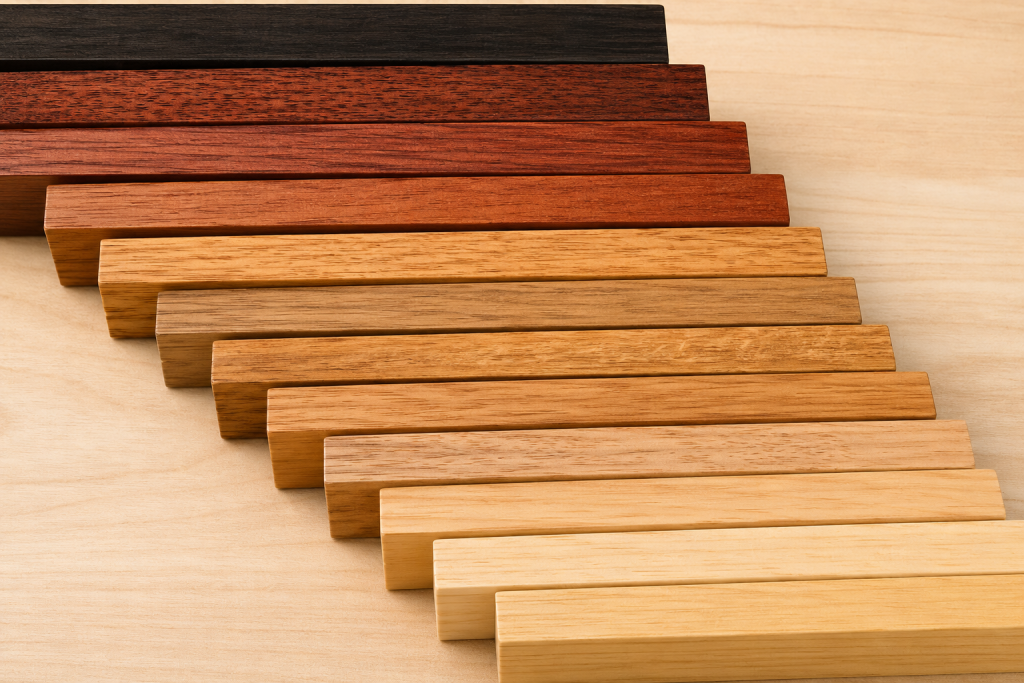
The same stain formula can also look different across species. Natural color, density, pore structure, grain, and sanding sequence all affect the result.
For custom stain work, create an approved control sample before production. The sample should use the same:
- Wood species
- Grade and cut
- Sanding sequence
- Stain system
- Application method
- Sealer
- Topcoat
- Sheen
Keep the approved sample available throughout the job. Compare production parts against it under consistent lighting to control color from the first part through final installation.
Hardness also does not determine whether a wood has open or closed grain. Oak has a pronounced open grain. Hard maple has a tighter surface. Ebony, mesquite, and bubinga each have different grain and finishing needs.
Test stains, fillers, sealers, and topcoats on production material before finishing a full run.
The Finish Provides Critical Surface Protection
The Janka rating measures the indentation resistance of the wood itself. It does not measure the protection provided by the finish.
A professional finish system can provide much of the surface’s resistance to:
- Scratches
- Abrasion
- Moisture
- Household chemicals
- Cleaning products
- Daily handling
This matters when a project calls for a softer wood but still needs maximum protection.
A durable catalyzed lacquer may provide enough protection for many cabinets and millwork applications. For tables, counters, commercial fixtures, and other high-wear surfaces, a polyurethane or acrylic-urethane system may provide greater abrasion and chemical resistance while retaining the flexibility needed for normal wood movement.
Do not compare finish hardness by one number alone. Coatings may be evaluated through pencil hardness, pendulum hardness, abrasion resistance, impact resistance, adhesion, flexibility, and chemical resistance.
Rockwell hardness may appear in some material data, but it does not provide a complete measure of a wood coating’s performance. Compare the stated test method along with the finish manufacturer’s abrasion, chemical, adhesion, and flexibility data.
Select the finish according to the application, not only the wood species.
Common Janka Scale Mistakes
Choosing the Hardest Available Wood
Extra hardness may add cost without improving the final product. Match the species to the actual wear level.
Choosing a Species Based on Hardness Alone
Woodworkers often choose a species for appearance, grain, color, availability, or project specifications.
Walnut is commonly selected for its look. Its moderate hardness supports the application, but it is usually not the main reason for choosing it.
Treating the Rating as an Exact Specification
Janka values are averages. Natural variation means an individual board may perform differently.
Ignoring Moisture and Stability
A hard wood can still move, warp, or crack when moisture conditions change.
Assuming Hardwood Always Means Hard
“Hardwood” and “softwood” are botanical classifications. They do not provide a direct measure of dent resistance.
Comparing Unlike Numbers
Confirm the unit and testing method. U.S. charts often use pounds-force. Other references may use newtons.
Assuming One Stain Formula Works on Every Species
The same stain formula can produce different colors on different woods.
Always approve a control sample made from the production species and complete finish schedule. Do not rely on a sample made from a different wood.
Relying on Wood Hardness for All Surface Protection
The Janka rating does not measure resistance to scratches, chemicals, moisture, or finish wear.
A softer wood with a durable lacquer or polyurethane system may perform better than a harder wood with an unsuitable finish.
Mixing Visible Species to Adjust Hardness
Most millwork jobs use one visible species to maintain uniform color, grain, texture, and stain response.
Mix species only when the design intentionally calls for contrast or when different materials will remain concealed.
Overlooking Production Costs
A material choice affects cutting speed, tool life, sanding labor, staining steps, finishing requirements, and reject rates. Include those costs when comparing species.
Extremely hard woods such as ebony, mesquite, and bubinga may provide excellent durability, but that benefit must justify the added material and production expense.
Final Takeaway: Janka Hardness Scale
Use the Janka wood hardness scale to compare resistance to dents, not to judge total wood quality or choose a species by hardness alone.
For most cabinet, furniture, and millwork projects, the right species balances appearance, hardness, stability, machining, finish, availability, and cost. Common species such as cherry, walnut, oak, and maple often provide that balance.
Walnut is usually chosen for its color and grain. Its moderate hardness is an added benefit. Most visible millwork jobs also use one primary species to maintain consistent color, grain, texture, and stain response.
Finishing plays an equally important role. Dense hardwoods may need a deep penetrating stain or dye system to reach the approved color. Always match custom stain work against a control sample made from the actual production species and complete finish schedule.
The topcoat provides much of the finished surface’s protection. A durable lacquer, polyurethane, acrylic-urethane, or other professional coating can improve resistance to scratches, abrasion, moisture, and chemicals. A strong finish system can also help a softer wood perform well in demanding applications.
Choose the wood for the required look and construction. Then select the stain and topcoat needed to meet the project’s color and performance goals.