
Choosing the right board is one of the most important decisions in any woodworking project. The material you select determines strength, durability, appearance, ease of machining, finishing quality, and long-term performance.
Whether you are building cabinetry, furniture, shelving, or shop fixtures, the best board is not the most expensive one. It is the one that matches your project’s purpose, environment, and construction method.
This guide walks through how professional woodworkers evaluate boards so you can choose with confidence.
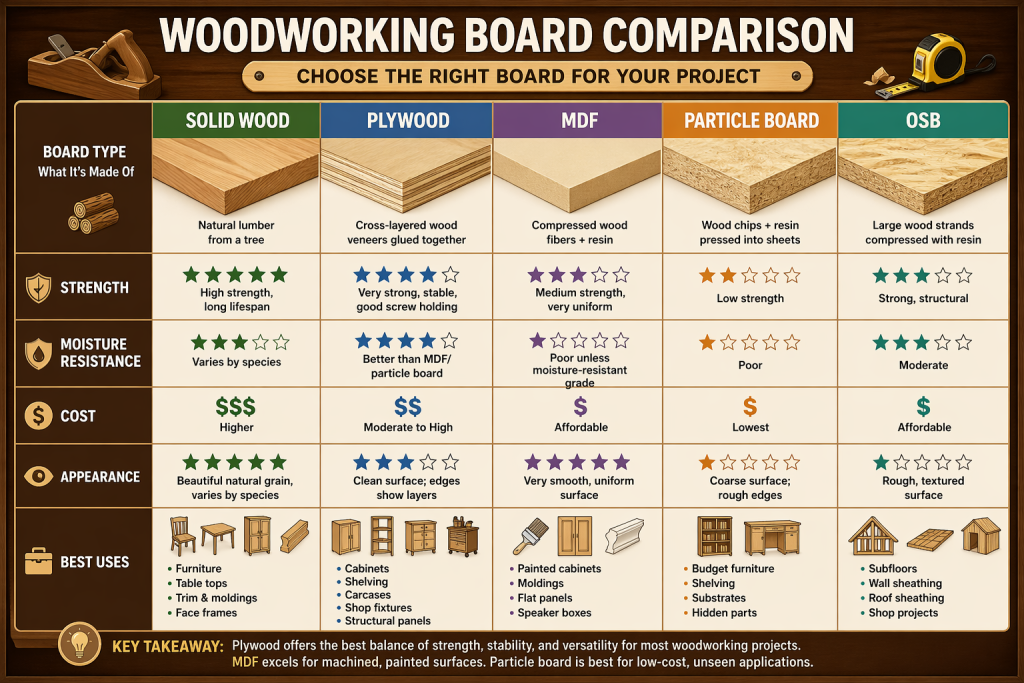
Quick Skim: Choosing the Right Board Type
| Board Type | What It’s Made Of | Strength & Durability | Moisture Resistance | Best For | Watch Outs |
|---|---|---|---|---|---|
| Solid Wood (Hardwood/Softwood) | Natural lumber from a tree | High strength, long lifespan | Varies by species | Furniture, trim, tabletops, face frames | Can warp or move with humidity |
| Plywood | Cross-layered wood veneers glued together | Very strong, stable, good screw holding | Better than MDF/particle board | Cabinets, shelving, structural panels | Exposed edges show layers, higher cost |
| MDF (Medium-Density Fiberboard) | Compressed wood fibers + resin | Medium strength, very uniform | Poor unless moisture-resistant grade | Painted cabinets, moldings, flat panels | Heavy, swells if wet, weak edge screws |
| Particle Board / Chipboard | Wood chips + resin pressed into sheets | Low strength | Poor | Budget furniture, shelving, substrates | Weak fastener holding, moisture damage |
| OSB (Oriented Strand Board) | Large wood strands compressed with resin | Strong, structural | Moderate | Subfloors, sheathing, shop projects | Rough surface, not furniture-grade |
Key takeaway: Plywood offers the best balance of strength, stability, and versatility for most woodworking projects, while MDF excels for machined, painted surfaces like cabinet doors and particle board is mainly for low-cost, unseen applications.
Start With the Project Requirements
Before looking at species or sheet goods, define what the piece must do.
Ask yourself:
- Will it carry heavy loads?
- Will it be exposed to moisture or temperature swings?
- Does appearance matter or will it be hidden?
- Will you paint or stain it?
- Does it need to hold screws well?
- What is your budget?
Furniture projects typically benefit from dense hardwoods for strength and appearance, while structural or utility projects often use more affordable softwoods.
Outdoor or damp environments require decay-resistant materials, while interior projects prioritize stability and finish quality.
Pro tip: Define function first. Material choice becomes much easier.
Understand the Three Main Board Categories
Most woodworking boards fall into three families: solid wood, plywood, and engineered panels.
Solid Wood Boards
Solid wood comes directly from milled lumber.
Common examples: oak, maple, cherry, walnut, pine, cedar.
Best for:
- Furniture
- Face frames
- Table tops
- Decorative pieces
- High-end cabinetry
Solid wood offers natural beauty, durability, and strength, making it ideal for pieces intended to last decades.
Hardwoods are dense and resilient, while softwoods are lighter, easier to work, and typically less expensive.
Trade-offs
- Can warp or move with humidity
- Usually more expensive
- Requires careful grain selection
Plywood
Plywood is made from thin wood veneers glued together in alternating grain directions.
This cross-layer construction gives plywood excellent strength and dimensional stability.
Best for:
- Cabinets
- Shelving
- Carcases
- Shop fixtures
- Structural panels
Hardwood plywood (birch, maple, walnut, oak veneer) provides strength plus a furniture-grade surface, making it a top choice for cabinetry.
Why professionals love plywood
- Resists warping better than solid wood
- Strong for its weight
- Available in large sheets
- Good moisture resistance (depending on grade)
Engineered Panels (MDF, Particle Board, OSB)
Engineered boards are made from wood fibers, particles, or strands bonded with resin under heat and pressure.
Common types include:
- MDF (medium-density fiberboard)
- Particle board / chipboard
- OSB (oriented strand board)
These materials are uniform and free of knots or grain defects.
Best for:
- Painted furniture
- Cabinet interiors
- Flat panels
- Budget projects
- Construction sheathing (OSB)
MDF and particle board are inexpensive and easy to machine, while OSB and plywood offer greater strength and moisture resistance.
Choose the Right Species or Material Properties
Once you pick a category, narrow down by performance characteristics.
Strength and Load Capacity
Denser woods generally support more weight and resist denting.
- Hardwood: best for furniture and structural pieces
- Softwood: suitable for framing and lighter applications
- Plywood: strong across large spans
- MDF: weaker at screw holding and bending
Dense wood is typically preferred for furniture and building applications.
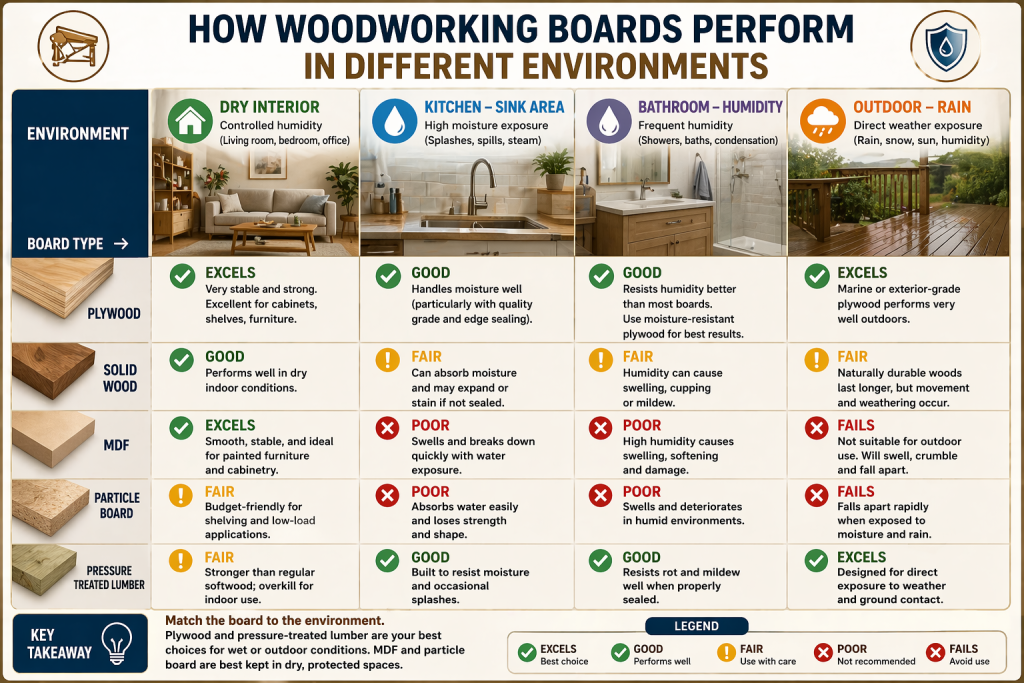
Moisture Resistance
Moisture is one of the biggest failure points in woodworking. Ensuring proper panels are used in high moisture areas like bathrooms and next to sinks or dishwashers. Phenolic glue is stronger than traditional formaldehyde-based glues for this option.
Choose materials based on environment:
- Outdoor: pressure-treated lumber, cedar, marine plywood
- Kitchens/baths: moisture-resistant plywood
- Dry interiors: most materials acceptable
OSB and plywood generally resist moisture better than MDF or particle board.
Stability and Movement
Wood expands and contracts with humidity.
Kiln-dried lumber has reduced moisture content, improving stability for indoor use.
Plywood’s cross-grain construction makes it especially resistant to warping.
Appearance and Finish
If the surface will be visible, grain and texture matter.
- Closed grain hardwoods produce a smooth finish
- Open grain woods show texture and character
- MDF is ideal for paint
- Veneered plywood balances appearance and stability
Wood texture also affects how stains and sealers absorb.
Evaluate Board Quality and Grade
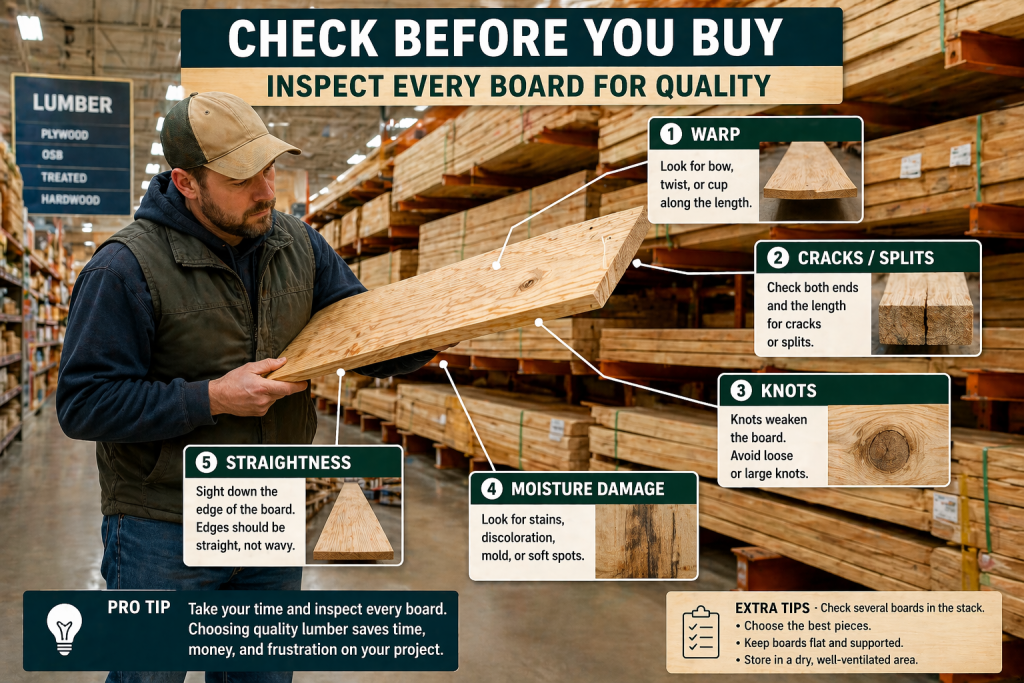
Not all boards of the same type are equal.
Key factors to inspect:
- Knots
- Cracks
- Warp or twist
- Moisture damage
- Surface defects
- Core voids (in plywood)
Higher grades contain fewer imperfections and produce cleaner finished work, though they cost more.
Consider Dimensions and Thickness
Boards come in standardized sizes, but nominal dimensions often differ from actual measurements.
For example, a “2×4” actually measures about 1.5″ × 3.5″ after milling and drying.
Always plan using actual dimensions, especially for precision projects like cabinetry.
Match the Board to the Construction Method
Think about how the piece will be assembled.
Choose materials that:
- Hold screws or fasteners well
- Accept glue properly
- Machine cleanly
- Allow joinery techniques you plan to use
Solid wood excels for traditional joinery, while plywood is ideal for cabinet construction. MDF machines cleanly but has weaker screw holding.
Balance Performance With Budget
There is no universally “best” board. Only the best board for your constraints.
Typical cost hierarchy:
- Solid hardwood (highest)
- Hardwood plywood
- Softwood lumber
- MDF / particle board (lowest)
Engineered boards often provide a cost-effective alternative to solid wood for many applications.
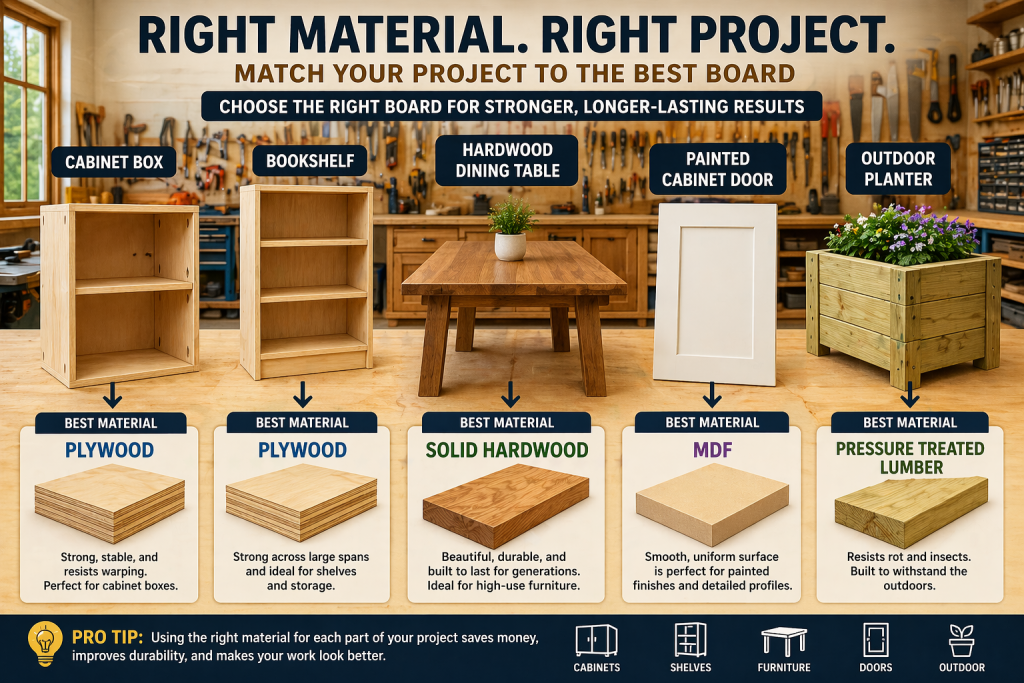
Quick Decision Guide
Use this as a fast starting point.
Furniture with visible wood grain
→ Solid hardwood or hardwood plywood
Cabinet boxes and shelving
→ Plywood
Paint-grade projects
→ MDF or high-quality plywood
Outdoor structures
→ Pressure-treated lumber or exterior-rated plywood
Budget shop projects
→ Construction lumber or particle board
Final Thoughts
The right board is not determined by tradition or brand. It is determined by performance requirements. Strength, stability, moisture resistance, appearance, machinability, and cost all play a role.
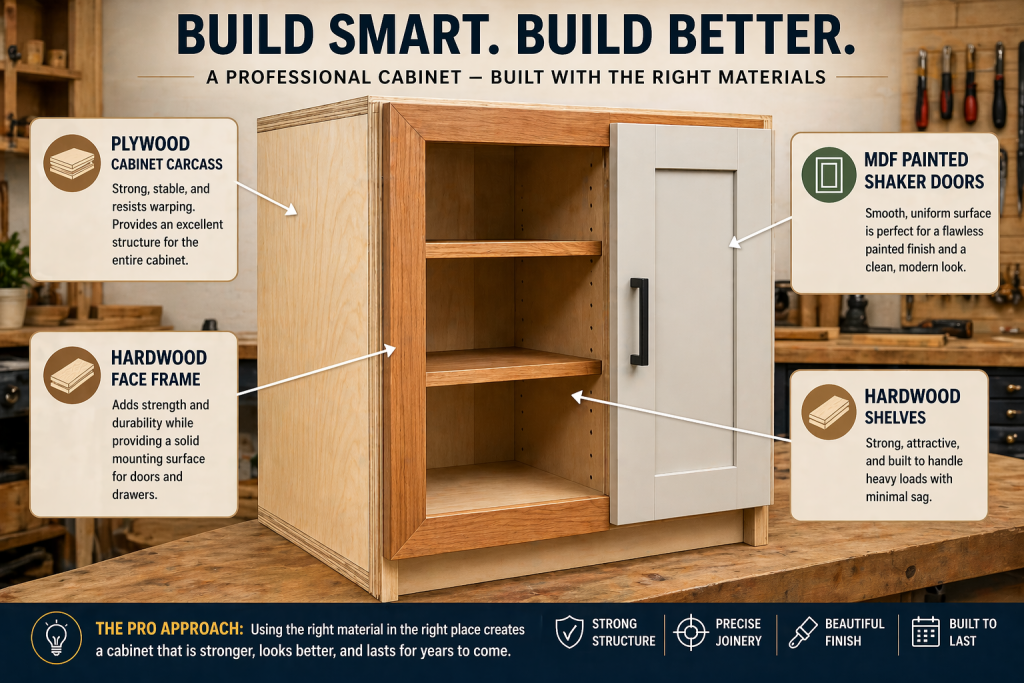
Professional woodworkers rarely use just one type of material in a project. They combine solid wood, plywood, and engineered panels strategically to get the best result.
Choose your board the same way: by matching material properties to real-world demands. Do that, and your project will not only look better, it will last longer and perform exactly as intended.