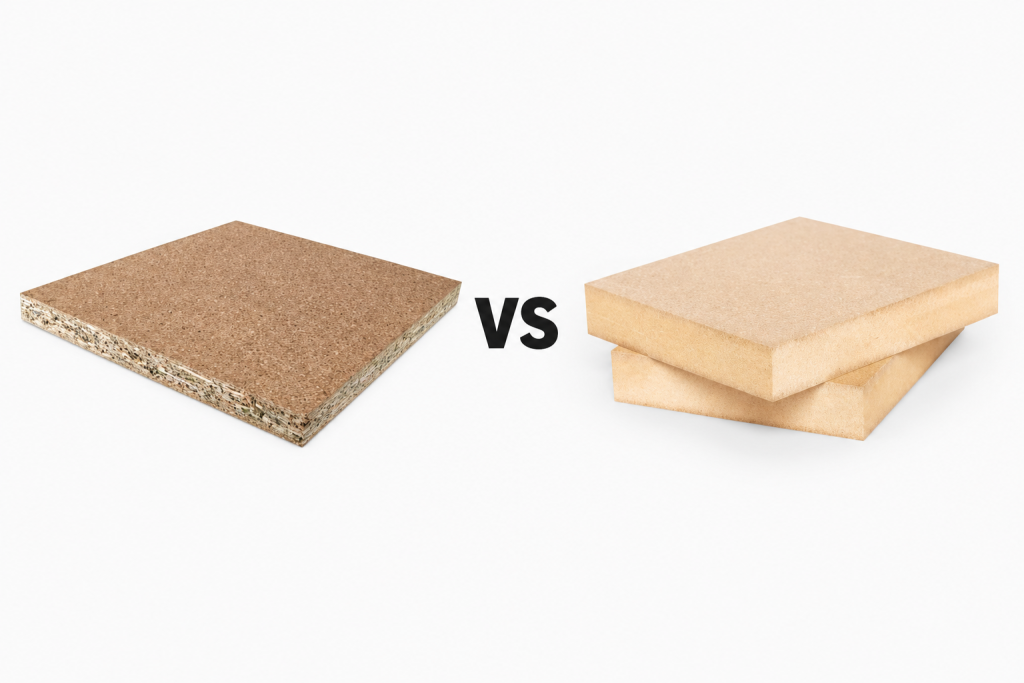

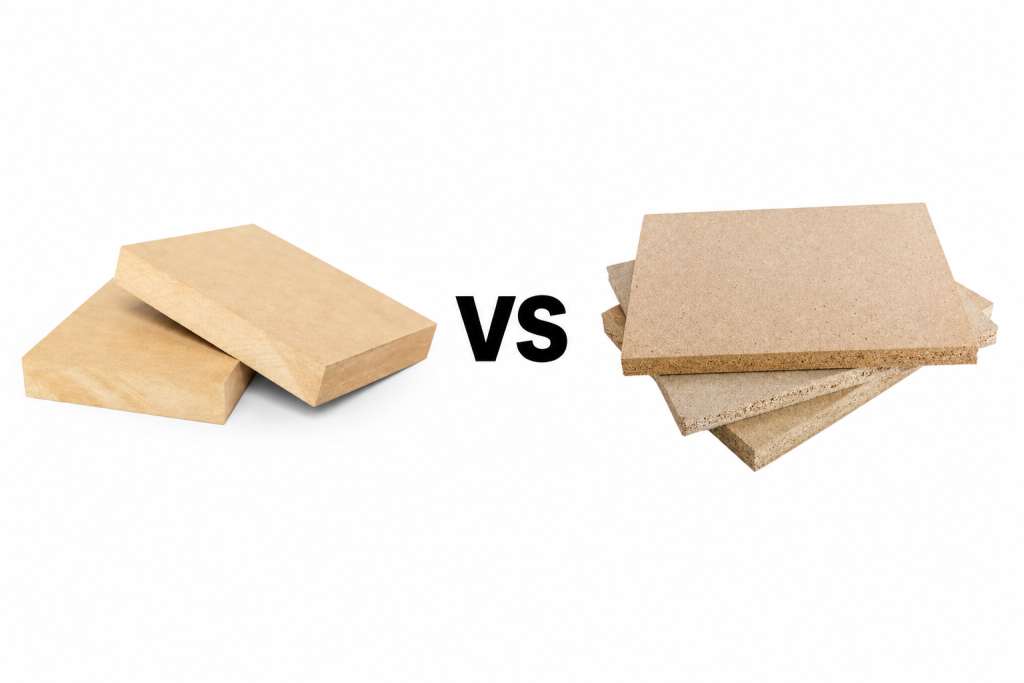
The main difference between Particle Board and Medium-Density Fiberboard (MDF) is the size and density of the wood material used to make them. MDF uses fine wood fibers compressed into a dense, smooth panel, while particle board uses larger wood particles that create a lighter, more economical core.
MDF is usually the better choice for painted surfaces, routed profiles, and parts that need a smooth, uniform edge. Particle board is often the better value for flat cabinet components, laminated panels, and production work where material cost matters.
However, MDF is not automatically stronger in every application. Panel grade, thickness, span, fastener location, and surface treatment can affect performance as much as the material type.
For professional shops, the better question is: Which panel has the right properties for the job?
Quick Skim: Particle Board vs MDF
| Factor | MDF | Particle Board |
|---|---|---|
| Core | Fine wood fibers bonded into a uniform panel | Larger wood particles bonded into a layered panel |
| Surface | Very smooth and consistent | Flat and well suited to laminates and TFL |
| Painted finishes | Excellent | Usually not the first choice for exposed paint-grade work |
| Routing and profiling | Excellent for detailed machining | Better suited to flat parts and simpler machining |
| Screw holding | Often stronger, but varies by grade and screw location | Adequate with the correct panel and fastener system |
| Shelf performance | Depends heavily on grade, thickness, load, and span | Also depends heavily on grade, thickness, load, and span |
| Weight | Usually heavier, though lightweight MDF is available | Often lighter than standard MDF |
| Moisture | Standard MDF can swell. Moisture-resistant grades are available | Standard particle board can swell. Finished faces improve surface protection |
| Cost | Usually higher | Usually lower |
| Best fit | Painted doors, routed parts, fixtures, decorative panels | TFL casework, cabinet boxes, furniture panels, cost-sensitive production |
What Is MDF?
Medium-density fiberboard, or MDF, is made by refining wood into fine fibers, mixing those fibers with resin and wax, and pressing the material into a dense panel.
Because the fiber structure is consistent through the panel, MDF machines predictably. It does not have grain, knots, or large particles that can interrupt a routed profile.
That makes MDF a strong fit for painted cabinet doors, routed panels, moldings, fixtures, furniture components, templates, and other parts that need smooth faces and edges. Industrial MDF manufacturers specifically position uniform-core panels for detailed profiling and finishing.
Würth Baer Supply offers standard, premium, lightweight, and moisture-resistant MDF options in multiple thicknesses and sheet sizes.
What Is Particle Board?
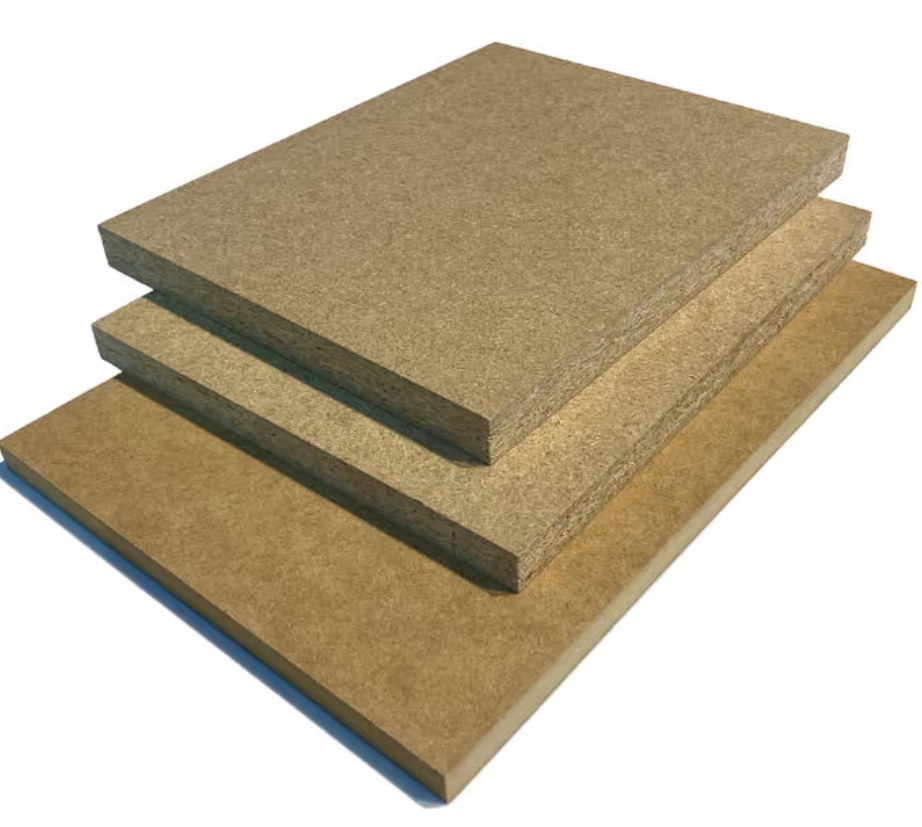
Particle board is made from wood particles bonded with resin and pressed into sheets. Unlike the fine, uniform fibers in MDF, particle board generally has a more visible particle structure.
That construction helps keep production costs down and creates a flat substrate that works well beneath decorative surfaces.
Particle board is common in commercial cabinetry, closets, office furniture, store fixtures, shelving, and other applications that use thermally fused laminate, melamine, veneer, or HPL.
This is one reason raw particle board should not be judged only by the appearance of its exposed edge. In many production applications, the particle board is the core, while the decorative surface provides the finished appearance and wear layer.
Würth Baer Supply carries particle board in a range of thicknesses and panel dimensions, including standard and low-emitting options.
MDF vs Particle Board for Painting and Finishing
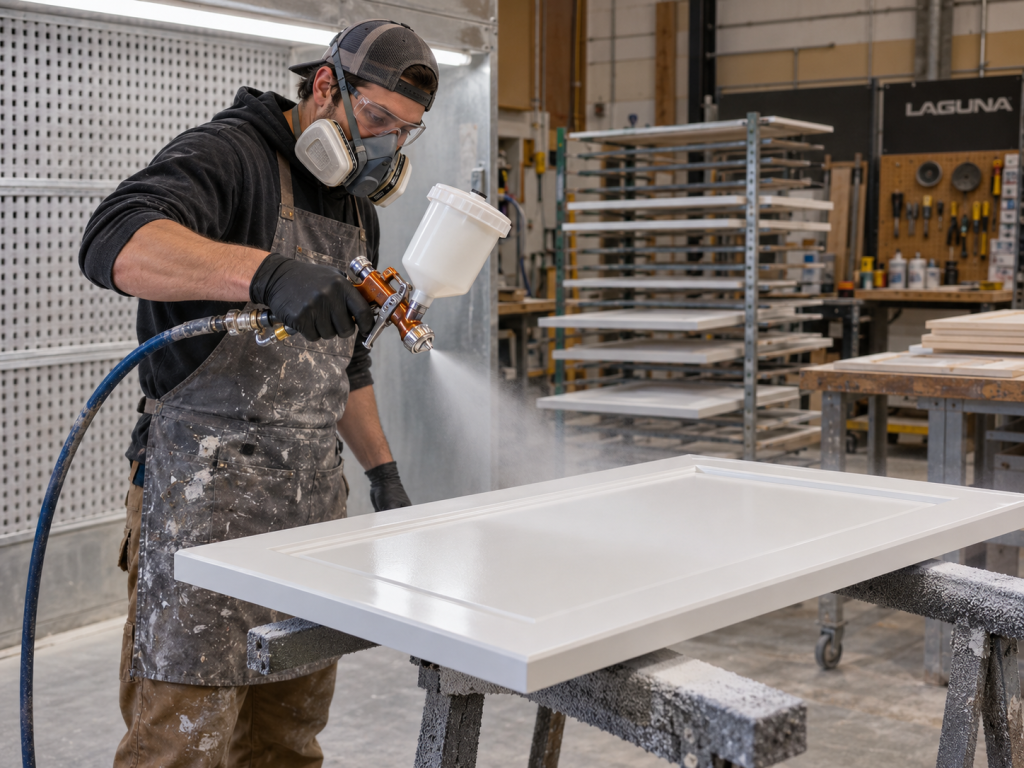
For paint-grade work, MDF usually has the advantage.
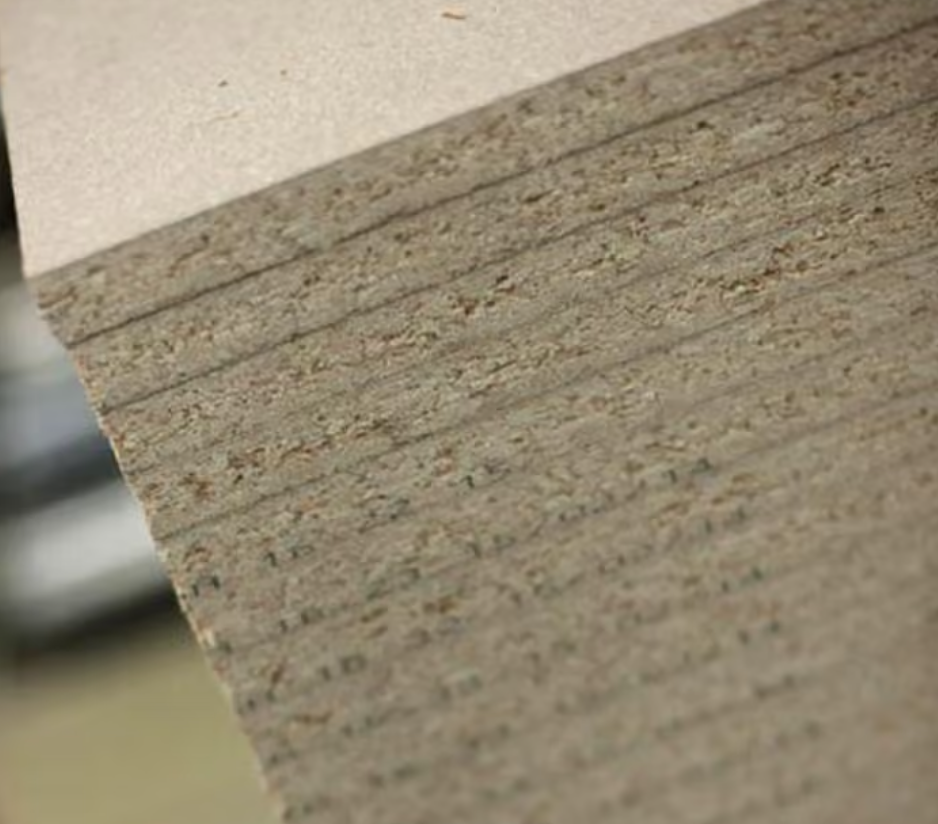
Its fine fiber structure creates a smooth face without wood grain or large particles. Routed MDF edges can also be prepared for a clean painted finish, which is why the material is widely used for cabinet doors and decorative profiles.
Particle board works differently. Its biggest strength is often as a substrate beneath another surface. TFL, melamine, veneer, and laminate can turn a particle board core into a ready-to-use cabinet or furniture panel.
For a production shop, that distinction affects labor as much as appearance.
A paint-grade MDF part may require machining, sanding, priming, painting, and curing. A prefinished TFL particle board panel may arrive ready for cutting, edgebanding, drilling, and assembly. The lower labor requirement can make particle board-based panels attractive for repeat casework even when raw MDF offers better machining.
Which Machines Better?
Choose MDF when the finished edge or routed profile matters.
MDF’s uniform core works well for CNC routing, decorative grooves, raised profiles, cutouts, and other detailed machining. There are no large internal particles to expose as the cutter moves deeper into the sheet.
Particle board performs well for panel processing, sizing, boring, and other production operations where the edge will be covered. Sharp tooling and correct feeds still matter because exposed particle board edges can chip if machining conditions are poor.
For either material, control dust at the machine. OSHA recommends local exhaust ventilation at or near the source for woodworking processes that create airborne wood dust.
Does MDF Hold Screws Better Than Particle Board?
Usually, but the full answer is more useful.
MDF often provides better screw-holding performance than standard particle board because of its denser, more uniform core. However, the exact result depends on the panel, screw type, pilot hole, edge distance, and whether the screw enters the face or edge.
Manufacturer specifications show why shops should compare actual data instead of relying on the material name alone.
For hardware-heavy components, look at the panel specification first. Use the correct pilot hole and fastener, avoid overdriving screws, and follow hardware and panel manufacturer recommendations.
Repeatedly removing and reinstalling a screw can also damage either composite core. Production joinery designed for composite panels can provide more reliable results than treating them like solid lumber.
Which Is Stronger: MDF or Particle Board?
This is where many comparisons become too simple.
MDF is generally denser and often has higher bending strength, but MDF is not automatically stiffer than every grade of particle board.
The Composite Panel Association publishes shelving data based on ANSI grades. Its mechanical-property table shows substantial overlap between the two materials.
For example, listed modulus of elasticity values for particle board grades range from about 250,200 psi to 362,600 psi. MDF grades in the same table range from about 180,000 psi to 405,000 psi.
In other words, a higher-performance particle board can be stiffer than a lower-grade MDF.
That distinction matters for cabinet shelves.
Shelf Sag Depends on More Than the Core
Shelf thickness, unsupported span, panel grade, load, shelf depth, and support design all affect deflection.
The Composite Panel Association’s shelf tables show how much these factors can change performance. For a 3/4-inch, single-span shelf carrying a uniformly distributed 30 psf load, published maximum spans vary from roughly 21 to 28 inches among the listed MDF grades and about 24 to 27 inches among the listed particle board grades.
That is a much more useful buying rule than simply saying “MDF sags less.”
For long shelving runs, reduce the unsupported span, increase thickness, add a center support, reinforce the front edge, or select a panel with the stiffness required by the design.
MDF vs Particle Board Around Moisture
Neither standard MDF nor standard particle board should be treated as waterproof.
Both contain wood material that can swell after water reaches the core. Cut edges, drilled holes, sink cutouts, damaged edgebanding, and unfinished areas deserve particular attention.
Surface material also changes the equation. TFL or another finished surface can improve resistance to spills on the face of the panel. ARAUCO, for example, notes that its TFL faces resist water and moisture. That protection does not make an exposed composite core waterproof.
For applications that may see higher humidity or occasional moisture, specify a panel designed for that environment. Würth Baer Supply carries moisture-resistant MDF products intended for applications subject to moisture exposure.
Moisture-resistant MDF is still not the same as an exterior panel. For sink bases, wet rooms, or areas where plumbing leaks are a realistic concern, evaluate the complete assembly and consider whether another panel type is more appropriate.
MDF vs Particle Board Weight
Standard MDF tends to be heavy because of its dense fiber structure. That can affect material handling, shipping, machine loading, installation, and finished product weight.
Particle board is often lighter, but density varies by product.
Shops should also know that MDF is available in lightweight and ultra-light versions. Würth Baer Supply carries lightweight MDF designed to reduce handling weight and transportation load while supporting applications such as decorative components and picture frames.
Always compare panel density when weight affects the job.
Particle Board vs MDF Cost
Particle board is generally the lower-cost raw panel.
That makes it attractive for large production runs, cabinet interiors, furniture components, closet systems, fixtures, and other applications where a laminated or veneered surface will cover the core.
MDF usually costs more, but its machining and finishing properties can justify the added material cost for paint-grade components.
For a shop, cost per sheet is only one part of the calculation.
A lower-cost panel that requires extra finishing, reinforcement, remakes, or slower machining may not deliver the lowest finished-part cost. A more expensive panel may pay for itself when it reduces sanding, improves CNC consistency, or delivers the finish the customer specified.
Compare the total process: material, machining time, tooling, finishing, hardware, handling, and callbacks.
Best Uses for MDF and Particle Board
| Application | Better Starting Point | Why |
|---|---|---|
| Painted cabinet doors | MDF | Smooth face and clean routed profiles |
| Routed decorative panels | MDF | Uniform core supports detailed machining |
| Paint-grade furniture parts | MDF | Easier to create a smooth finished surface |
| TFL cabinet boxes | Particle board | Cost-effective core with a ready-to-use decorative face |
| Closet and office casework | Particle board | Efficient for repeat flat-panel production |
| Laminated furniture | Particle board or MDF | Choose based on machining and performance needs |
| Long shelves | Check panel grade and span | Thickness and stiffness can matter more than core name |
| Hardware-heavy assemblies | Check screw-holding specs | Fastener performance varies by product and screw location |
| Humid interior locations | Moisture-resistant grade | Standard panels should not be assumed to resist water |
What Should You Check Before Ordering?
Do not stop at “MDF” or “particle board” on the quote. Check the actual panel specification.
Thickness and density matter. Two panels with the same core type may behave differently because they have different densities or performance grades.
Check stiffness when the part spans a distance. Modulus of elasticity, shelf thickness, and support spacing affect sag.
Check screw-holding data when hardware carries repeated loads. Face and edge performance may differ.
Match the finish to your process. Raw MDF makes sense for paint and routing. Prefinished particle board can reduce finishing labor for production casework.
Specify moisture performance when needed. A moisture-resistant grade and good edge treatment can be more important than simply choosing MDF over particle board.
Check emissions and certifications. MDF and particle board sold in the United States fall under EPA TSCA Title VI formaldehyde requirements. EPA requires regulated composite wood products to meet applicable emission standards and labeling requirements. ULEF, NAF, FSC, recycled-content, and other attributes are separate product-level considerations that may also matter to your specification.
Particle Board vs MDF: Which Should You Choose?
For most professional woodworking shops, there is no reason to use one material everywhere.
Choose MDF for painted, routed, and highly machined parts where surface quality and a uniform core matter.
Choose particle board for cost-efficient flat-panel construction, especially when you plan to use TFL, melamine, laminate, or another finished surface.
For shelves, hardware, and demanding assemblies, go one step further. Compare the actual grade and technical data instead of assuming that MDF always provides more strength.
That approach gives you a panel that fits the job, the production process, and the customer’s performance requirements.
Final Takeaway: Particle Board vs MDF
Particle board and MDF solve different production problems. MDF excels at smooth finishes and detailed machining. Particle board delivers strong value for flat, surfaced components and high-volume casework. The best choice comes from matching the panel’s grade, thickness, finish, fastener performance, moisture exposure, and cost to the finished part.
Würth Baer Supply stocks a broad range of MDF sheet stock and particle board panels for cabinet, furniture, fixture, and woodworking applications. Product availability and specifications vary by market.