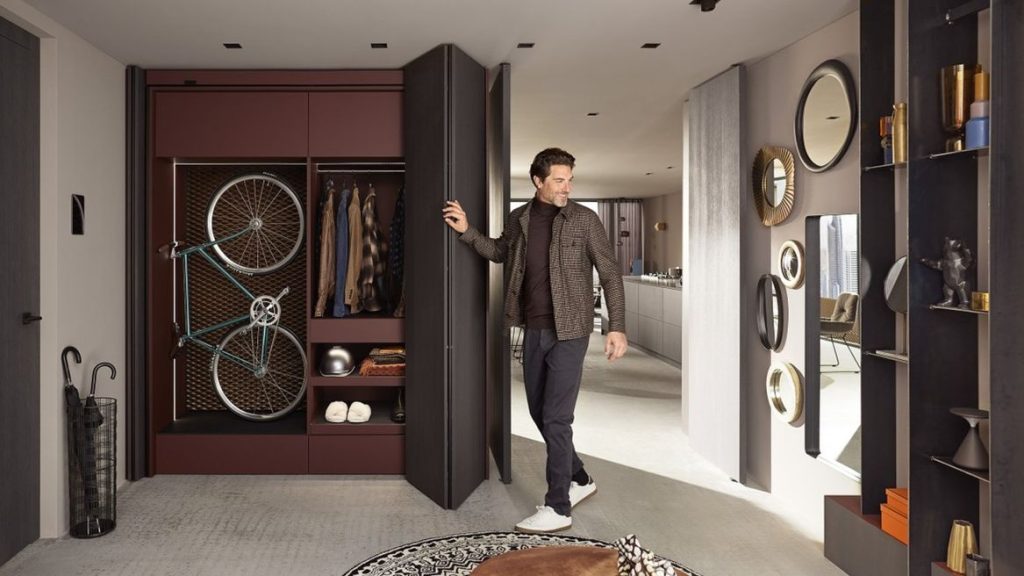

The main difference between flipper vs pocket doors is that pocket doors slide into the sides of a cabinet, while flipper doors lift upward and retract into the top. Both keep open doors out of the way, but each requires a different cabinet layout and hardware system.
Pocket doors work best for tall pantry cabinets, appliance garages, and concealed storage. Flipper doors are a better fit for upper cabinets, microwave cubbies, and overhead storage.
For cabinet shops, the right choice depends on door size, cabinet depth, interior clearance, and installation needs. Brands like Blum, Salice, and Sugatsune offer pocket door systems, retracting mechanisms, and lift-up solutions for different applications.
Quick Skim: Flipper Doors vs Pocket Doors
| Feature | Pocket Doors | Flipper Doors |
|---|---|---|
| Door movement | Swing open and slide sideways | Lift upward and slide backward |
| Storage location | Cabinet sides | Cabinet top |
| Best for | Pantries, appliance garages, concealed kitchens | Upper cabinets, microwave cubbies, overhead storage |
| Main benefit | Full access without doors blocking walkways | Clear upper cabinet access |
| Space trade-off | Reduces usable side space | Reduces usable interior height |
| Hardware examples | Blum REVEGO, Salice Exedra, Sugatsune ALT | Sugatsune IF-360W |
| Other options | Single and double pocket systems | Blum AVENTOS and Salice Wind lift-up systems |
What Is the Difference Between Flipper and Pocket Doors?
The main difference is how each door moves and where it sits when open.
How Pocket Doors Work
Pocket doors typically swing outward before sliding horizontally into a space along the cabinet side. Some specialized systems use assisted movement to make opening and closing easier.
Once retracted, the doors leave the cabinet opening clear.
Pocket doors are ideal for:
- Tall pantry cabinets: Keep large doors out of busy kitchen walkways.
- Appliance garages: Hide coffee makers, mixers, and other small appliances.
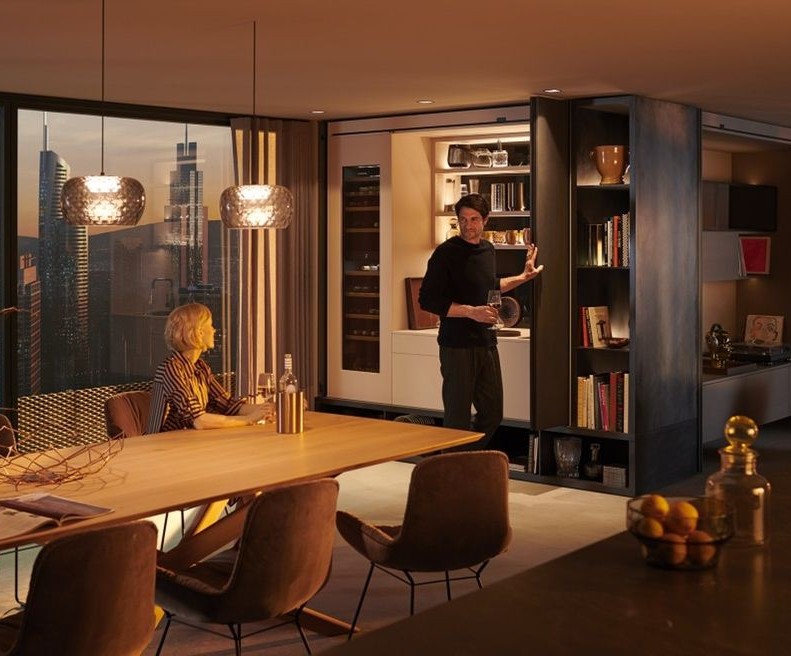
- Concealed kitchens: Create a clean, uninterrupted wall of cabinetry.
- Home offices and entertainment centers: Conceal equipment when not in use.
The main trade-off is cabinet space. Pocket systems need room for the door, slides, and supporting hardware.
Depending on the mechanism, shops may also need dedicated side compartments or modifications to the interior shelving.

How Flipper Doors Work
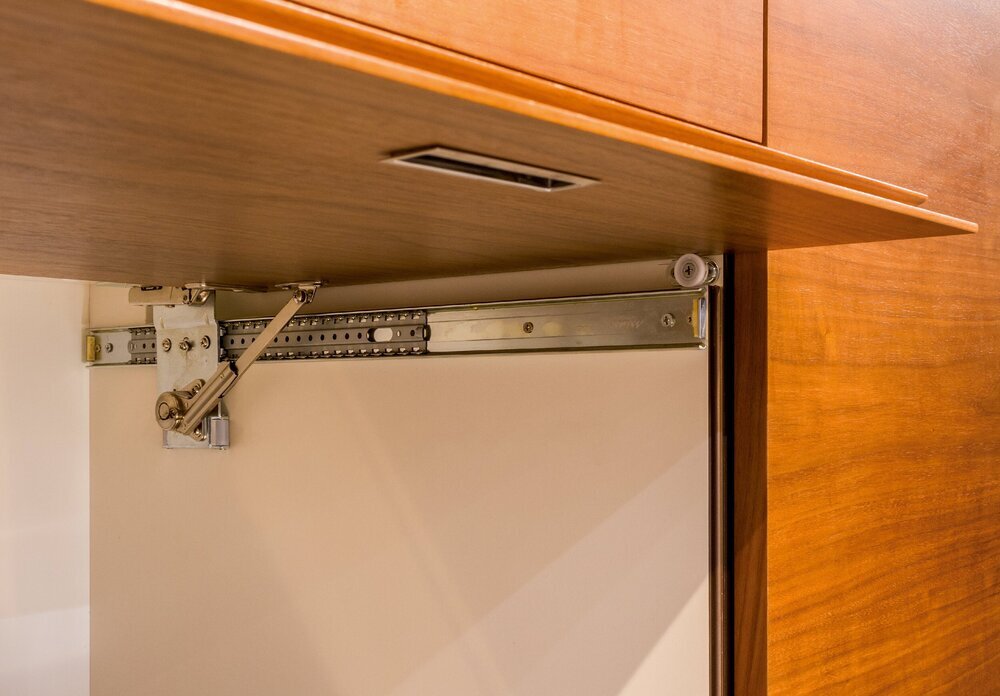
Flipper doors lift upward and slide horizontally into the upper section of the cabinet.
Unlike a standard hinged lift-up door, a true flipper door retracts inside the cabinet instead of remaining above the opening.
Flipper doors work well for:
- Upper kitchen cabinets: Keep open doors clear of the work area.
- Microwave compartments: Provide access without an extended door.
- Office cabinetry: Hide overhead storage while preserving workspace.
- Appliance cubbies: Create concealed storage in compact spaces.
The main trade-off is interior height. The door and slide hardware occupy space near the cabinet top.
For cabinet shops, that means planning the door’s travel path before setting shelf positions or cabinet dimensions.
Comparing Pocket Door Systems From Blum, Salice, and Sugatsune
Not all pocket door mechanisms work the same way.
Blum, Salice, and Sugatsune offer solutions with different construction requirements, movement controls, and installation features.
Blum REVEGO: Best for Large Concealed Cabinet Areas
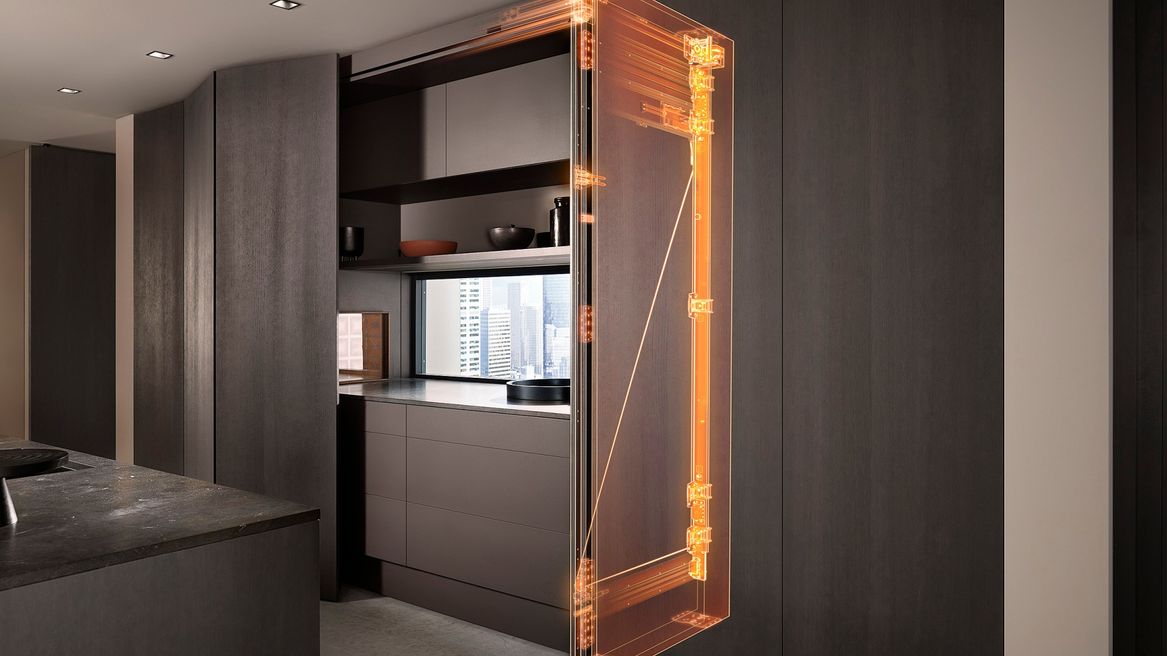
Blum REVEGO is a pocket door system designed to conceal larger sections of cabinetry and living spaces.
The system uses a dedicated, narrow cabinet compartment that houses the door and its operating mechanism.
When opened, the full-overlay doors retract into the pocket, revealing the storage or workspace behind them.
Key features:
- REVEGO uno supports single-door applications.
- REVEGO duo supports double-door applications.
- Integrated pocket construction simplifies planning around the system.
- Standardized pocket widths support consistent cabinet layouts.
- The system can conceal larger cabinet runs and functional spaces.
Best applications: Hidden kitchens, pantries, laundry areas, and home offices.
Buying consideration: REVEGO requires a dedicated pocket cabinet and careful dimensional planning. It is better suited to larger concealed openings than a small appliance cubby.
For shops designing full-height concealed storage, REVEGO provides a coordinated system rather than a collection of separate slides and hinges.
Salice Exedra: Best for Smooth, Assisted Pocket Door Movement
Salice offers several pocket door systems, including Exedra, Exedra Gravity, and Exedra2.
These systems focus on smooth movement and concealed storage, with options for different door sizes and opening configurations.
Salice Exedra uses assisted sliding and linear damping to control door movement. It supports doors weighing up to 88 pounds, depending on the configuration.
Salice Exedra Gravity offers assisted door insertion or extraction, depending on the selected version. It operates without cables, tie rods, or springs and includes accessible door adjustments.
Salice Exedra2 supports two linked doors that move together. The Smart version requires less cabinet depth, while the Star version conceals the pocket mechanism behind a front cover panel.
Key features across the range:
- Assisted door movement.
- Controlled insertion and extraction.
- Single-door and coordinated double-door options.
- Hardware configurations for concealed storage.
- Adjustment features to help maintain proper door alignment.
Best applications: Full-height pantry cabinets, concealed kitchen sections, laundry storage, and home office cabinetry.
Buying consideration: Door size, opening direction, cabinet depth, and the selected Exedra model determine which components the project requires.
For shops seeking controlled movement on larger concealed cabinet fronts, Salice provides several options.
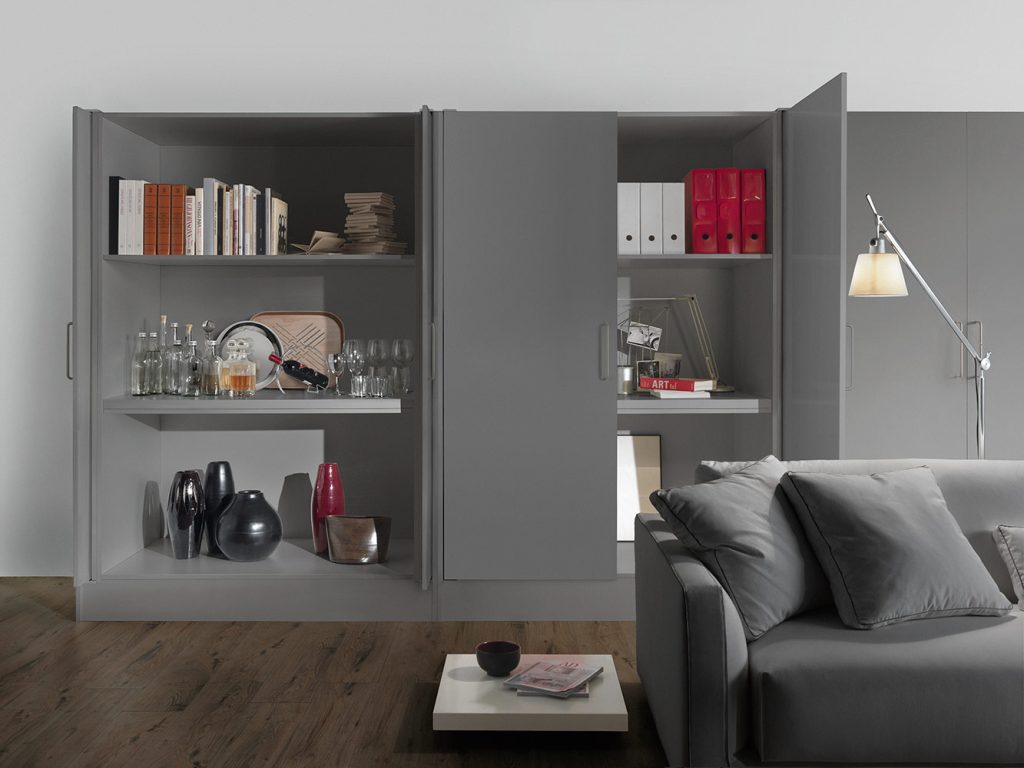
Sugatsune ALT: Best for Adjustable Cabinet Pocket Doors
The Sugatsune ALT pocket door system offers a practical solution for cabinet shops that want adjustable hardware and straightforward installation.
Unlike some pocket systems, certain ALT configurations do not require separate pocket gables.
The mechanism uses slide rails, European-style hinges, and a connecting bar with built-in anti-sag adjustment.
Key features:
- Adjustable anti-sag support helps keep doors aligned.
- Olympia soft-close hinges offer five closing-speed settings per hinge.
- Slide and hinge construction supports a familiar installation process.
- Inset and overlay configurations accommodate different cabinet designs.
- Various kit sizes support different door dimensions.
Certain ALT configurations accommodate doors up to 94 1/2 inches tall and 44 pounds. Exact limits depend on the selected kit.
Best applications: Tall pantry cabinets, appliance garages, and custom storage cabinets.
Buying consideration: Although the hardware may not require a separate pocket gable, interior shelving must account for slide placement. Shops may need to build an internal compartment to support shelves.
For installers who value accessible adjustment features, ALT offers a practical option.
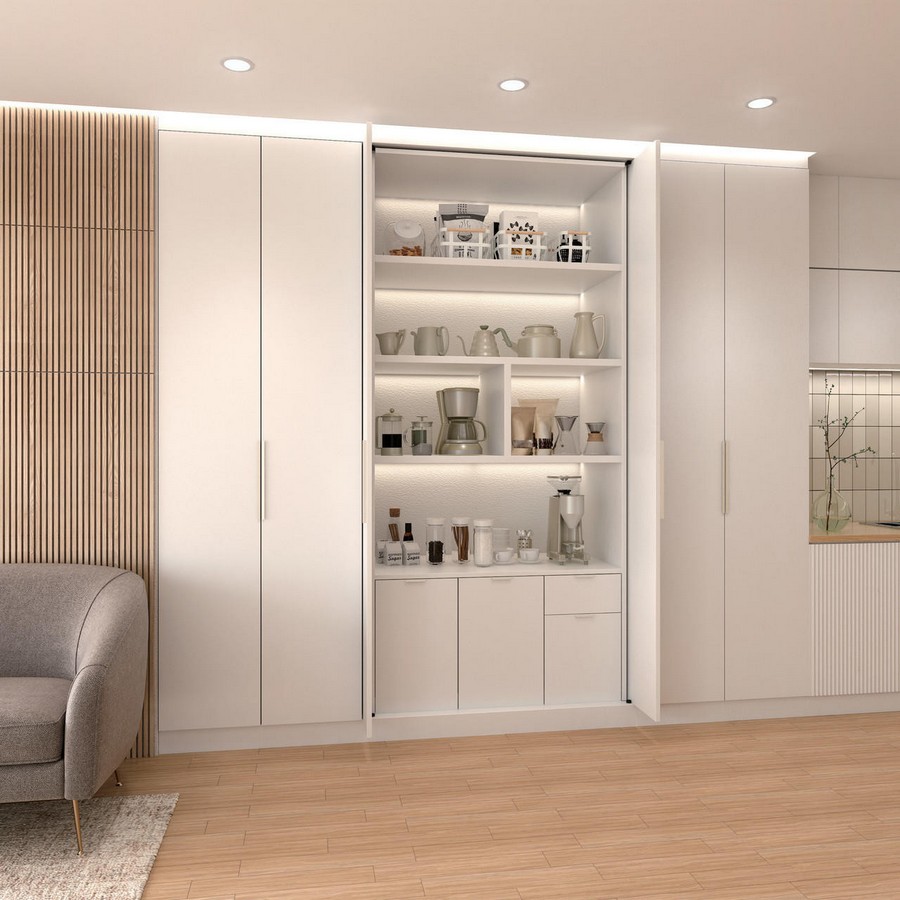
Flipper Door Hardware and Lift-Up Alternatives
Flipper doors are not the only way to keep upper cabinet doors out of the workspace.
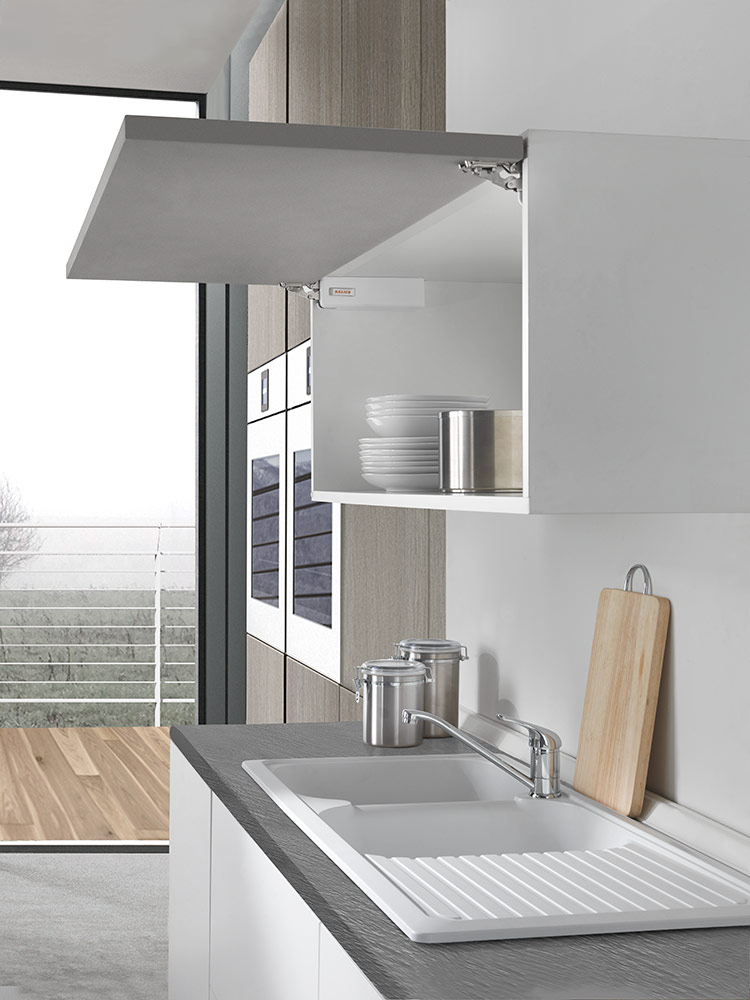
Blum and Salice also offer lift-up systems that move doors above the cabinet opening. These mechanisms serve many of the same applications, but they do not store the door inside the cabinet.
Understanding that difference helps shops select the correct hardware.
Sugatsune IF-360W: True Retracting Flipper Doors
The Sugatsune IF-360W is a retracting flipper door mechanism designed for upper cabinet applications.
The door lifts upward and slides into the top of the cabinet, leaving the opening clear.
Key features:
- Side-mounted rails guide the door into the cabinet.
- Hold-open support keeps the door in position.
- Soft-close operation controls movement during closing.
- A guiding roller helps the door transition smoothly between positions.
Best applications: Microwave cubbies, upper appliance garages, and overhead storage.
Buying consideration: The mechanism requires enough cabinet depth and overhead space to store the open door.
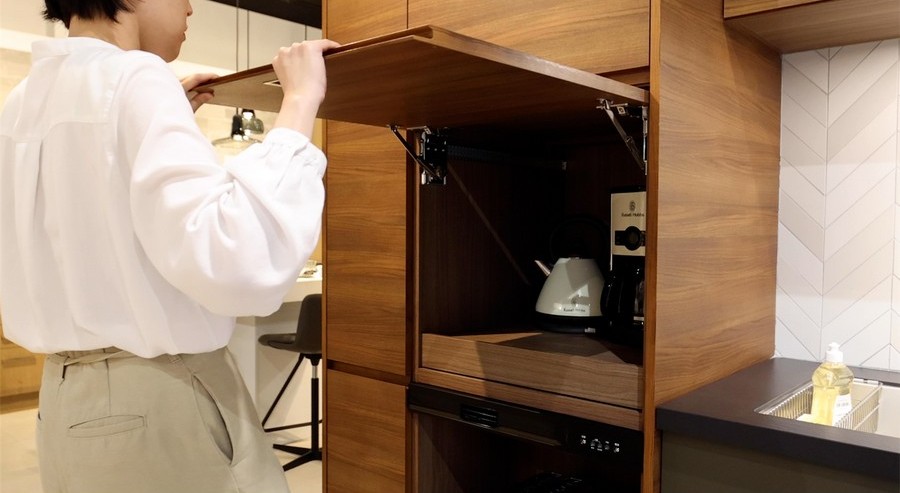
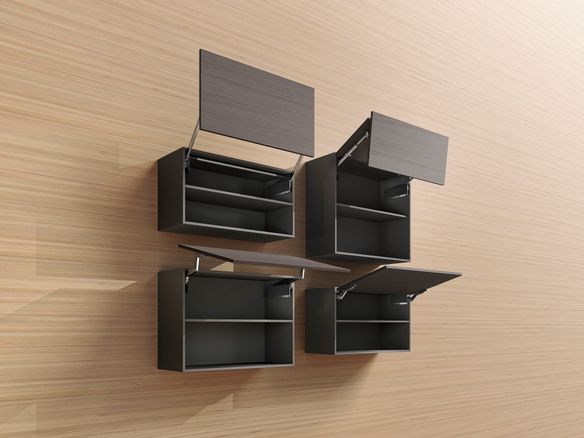
Blum AVENTOS: Lift-Up Access Without a Retracting Door
Blum AVENTOS offers several ways to move upper cabinet doors out of the way.
Unlike a flipper mechanism, AVENTOS lifts or folds the door above the opening rather than sliding it inside the cabinet.
Different models suit different door styles:
- AVENTOS HF top: Folds a two-part door upward.
- AVENTOS HS top: Swings a single door up and over the cabinet.
- AVENTOS HL top: Raises a single door vertically while keeping it parallel to the cabinet front.
- AVENTOS HK top: Pivots a single door upward.
These systems include BLUMOTION soft-close technology and adjustment features for controlled movement.
Best applications: Wall cabinets, upper kitchen storage, and projects where a full pocket mechanism is unnecessary.
Buying consideration: Check the clearance above the cabinet, the movement path, and the door’s weight. These systems need a different layout than a true retracting flipper door.
Salice Wind: Compact Lift-Up Hardware for Upper Cabinets
Salice Wind is a compact lift system for single-panel cabinet doors.
It mounts to the cabinet sides and supports upward-opening doors without requiring a full retracting track.
Wind offers soft-close and push-opening versions, along with adjustable spring strength.
Key features:
- Compact hardware that takes up limited cabinet space.
- Controlled lifting and closing movement.
- Adjustable spring strength for different door weights.
- Options for handleless cabinet designs.
- Multiple cover finishes for a clean interior appearance.
Best applications: Upper kitchen cabinets, bathroom storage, office cabinetry, and smaller overhead compartments.
Buying consideration: Wind is a lift-up system, not a retracting flipper system. The open door remains above the cabinet opening rather than sliding inside.
Which Cabinet Door Hardware Is Right for Your Project?
Each system addresses a different cabinet design need.
| Product | Door movement | Best application | Primary buying factor |
|---|---|---|---|
| Blum REVEGO | Side-retracting pocket | Concealed kitchen walls and large storage areas | Dedicated pocket construction |
| Salice Exedra / Exedra Gravity | Assisted side retraction | Tall pantries and concealed workspaces | Controlled movement and door dimensions |
| Salice Exedra2 | Linked double-door retraction | Wide concealed openings | Coordinated door movement |
| Sugatsune ALT | Side-retracting pocket | Pantry and appliance cabinets | Anti-sag adjustment and installation |
| Sugatsune IF-360W | Upward lift with overhead retraction | Microwave cubbies and upper cabinets | Overhead storage clearance |
| Blum AVENTOS | Lift, fold, or pivot upward | Wall cabinets | Door size and opening style |
| Salice Wind | Single-panel lift-up | Compact upper cabinets | Low-profile hardware and lift support |
What Should Cabinet Shops Consider Before Installation?
Before ordering, check five factors that affect both hardware selection and cabinet construction.
1. Cabinet Dimensions
Measure the available cabinet depth, width, and height.
Pocket doors need space along the cabinet sides. Flipper doors require overhead clearance and enough depth for the retracted panel.
Lift-up systems also need clearance above or in front of the cabinet.
2. Door Weight and Size
Check the hardware manufacturer’s ratings for door height, width, thickness, and weight.
Large panels place greater demands on hinges, slides, and support mechanisms.
Do not assume that systems from different brands support the same door dimensions.
3. Interior Storage Requirements
Consider how the mechanism affects usable cabinet space.
Pocket door compartments can reduce interior width. Flipper tracks occupy overhead space. Lift-up mechanisms may use less internal space, but the door stays outside the cabinet when open.
Plan shelf positions around the selected mechanism.
4. Installation and Adjustment
Hardware selection can affect shop labor.
Look for features that help with installation and setup, including adjustable mounting positions, accessible alignment controls, installation templates, and soft-close adjustments.
For large or heavy doors, these features can help installers achieve consistent operation.
5. Project Cost and Long-Term Performance
Compare the complete installed cost, not just the hardware price.
Include the time needed for cabinet preparation, mounting, door alignment, and final adjustment.
Premium pocket systems can offer added movement control and coordinated door operation. Simpler lift-up hardware may provide the access a project needs without complex pocket construction.
Choose the system that matches the application and project budget.
Final Takeaway: Pocket, Flipper, or Lift-Up Doors?
Choose pocket doors when you need to conceal tall cabinets or large storage areas without leaving doors in the walkway. Blum REVEGO, Salice Exedra, and Sugatsune ALT provide different solutions based on the size of the opening, desired movement, and cabinet construction.
Choose flipper doors when you need the door to retract into the top of an upper cabinet. The Sugatsune IF-360W is designed for this type of overhead storage.
For projects that need clear upper cabinet access but not full door retraction, Blum AVENTOS and Salice Wind offer practical lift-up alternatives.
Würth Baer Supply carries cabinet door hardware from Blum, Salice, Sugatsune, and other manufacturers to support a wide range of woodworking projects.
Explore pocket door slides, overhead flipper slides, and lift systems to find the right mechanism for your next cabinet build.