
If you buy hardwood plywood for cabinets, casework, or furniture, you’ve probably heard terms like veneer core, crossbanding, rift cut, or B/BB and had to stop and double-check what they mean.
This glossary breaks down the most important hardwood plywood terms in plain language so you can spec panels faster, avoid ordering mistakes, and get the results you expect in the shop (and what your clients expect on their project).
If you’re ready to shop now, Würth Baer Supply has everything you need!
Quick Skim: Hardwood Plywood Glossary
| Term | What It Means (Short Version) |
|---|---|
| Back | The reverse side of the face veneer |
| Bark Pocket | Bark trapped inside the wood |
| Core | The center layer(s) of a plywood panel |
| Crossbar | Grain irregularity running across the board |
| Crossbanding | Inner plies placed at 90° to the adjacent plies (cross banding is done on a ply-by-ply basis) |
| Defects | Anything that breaks a smooth surface |
| Delamination | Layers separating due to adhesive failure |
| Face | The best-looking side of the panel |
| Grain | Fiber pattern and direction in wood |
| Gum Spots | Resin pockets that can show through veneer |
| Half-Round Slicing | Off-center slicing that blends cut styles |
| Hardwood | Deciduous wood (not “hardness”) |
| Heartwood | Mature, darker center of the tree |
| Knot | Branch base embedded in wood |
| Open Knot | Knot that drops out and leaves a hole |
| Pin Knot | Small sound knot under 1/4” |
| Sound Knot | Solid knot that stays in place |
| Knothole | Hole left behind by a missing knot |
| Lap | Veneer overlap in a ply layer |
| MDF | Smooth engineered fiber core material |
| Mineral Streak | Natural discoloration in wood/veneer |
| Particleboard | Pressed wood chips used as a core |
| Patches | Inserts used to repair veneer defects |
| Plain Sliced | Veneer cut tangent to growth rings |
| Ply | A single veneer layer in plywood |
25 Hardwood Plywood Terms Cabinet Shops Should Know
1) Back
The back is the reverse side of a hardwood plywood panel. It’s usually the lower-grade side when a panel has a “good face” and a “utility back.”
Why it matters: Saves money when the back won’t be visible inside cabinets or wall paneling.
2) Face
The face is the best-looking side of the plywood panel. It’s the side you design around and show on finished cabinetry.
Why it matters: This is where grade, veneer cut, and matching style matter most.
3) Core
The core is the center of the panel. It can be veneer, MDF, particleboard, or other engineered materials.
Why it matters: Core choice affects weight, screw holding, machining, and stability.
4) Ply
A ply is one single layer of veneer inside plywood. Multiple plies are stacked and bonded to build thickness.
Why it matters: More plies often means better stability and cleaner machining.
5) Hardwood Plywood
Hardwood plywood is a panel made from inner layers (plies) bonded together with adhesive, with a hardwood veneer face and back.
Why it matters: It’s the standard panel product for cabinetry, furniture, and architectural millwork.
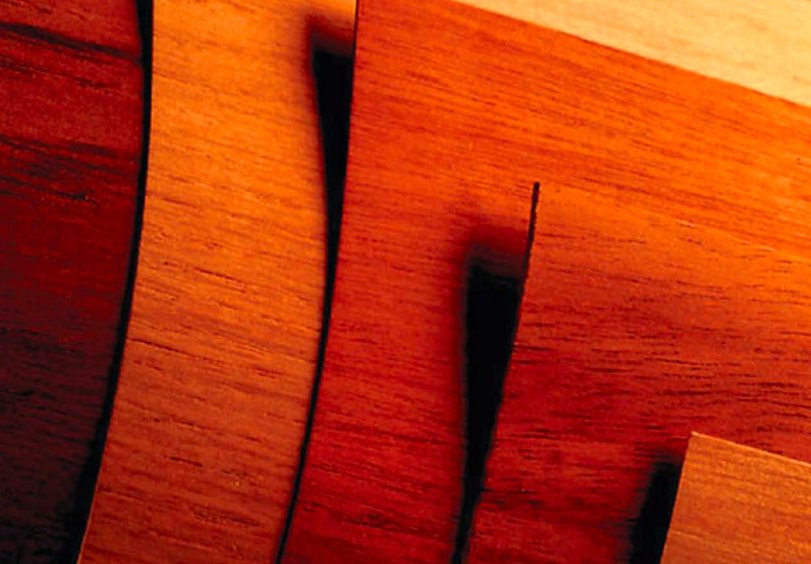
6) Veneer
Veneer is a thin sheet of wood that’s peeled or sliced. It is typically used as the decorative face.
Why it matters: Veneer species and cut determine the final look of the panel.
7) Grain
Grain is the pattern, direction, and size of wood fibers.
Why it matters: Grain affects appearance, finishing, and how panels look across cabinet runs.
8) Crossbanding
Crossbanding is an inner ply veneer placed at a right angle (90°) to the core, face, and back.
Why it matters: Improves stability and reduces warping.
9) Crossbar
A crossbar is an irregularity in the wood grain running across the length of the board.
Why it matters: It can change appearance and affect finishing consistency.
10) Defects
Defects are anything that interrupts the smooth surface of the wood. Examples include knots, splits, voids, and wormholes.
Why it matters: Grade is basically a controlled list of allowable defects.
11) Delamination
Delamination is when inner plies separate, usually because the adhesive bond fails.
Why it matters: Delamination can ruin a panel during machining, assembly, or after installation.
12) Knot
A knot is the circular portion of wood that formed where a branch grew from the tree trunk.
Why it matters: Knots affect strength and appearance.
13) Sound Knot
A sound knot is solid and stays in place.
Why it matters: Sound knots may be acceptable in certain grades and applications.
14) Pin Knot
A pin knot is a small sound knot less than 1/4” in diameter.
Why it matters: Often allowed in higher grades because they’re less noticeable.
15) Open Knot
An open knot is a knot that has loosened or dropped out, leaving an opening.
Why it matters: Open knots usually require patching or are only acceptable in low-grade panels.
16) Knothole
A knothole is the hole left when a knot drops out of the wood.
Why it matters: Not ideal for finished cabinetry unless the look is intentional.
17) Bark Pocket
A bark pocket is a small area of bark trapped in the wood as the tree grew.
Why it matters: It’s a natural flaw that can weaken or visually disrupt the face veneer.
18) Splits
Splits are separations in the wood fiber running parallel to the grain.
Why it matters: Splits can telegraph through finishes and weaken edges.
19) Lap
A lap is when one piece of veneer overlaps another in the same ply layer.
Why it matters: Can show through thin veneers or create inconsistent sanding results.
20) Patches
Patches are filler inserts used to repair defects in veneer or panels.
Why it matters: Patch visibility varies by grade and species.
21) Mineral Streak
A mineral streak is a natural discoloration in hardwood or hardwood veneer.
Why it matters: It can be desirable character or a problem depending on the project.
22) Gum Spots
Gum spots are resinous accumulations found on panel surfaces.
Why it matters: They can sometimes be sanded out, but they may affect stain absorption.
23) Heartwood
Heartwood is the mature center of the tree that has stopped growing. It’s typically darker than sapwood.
Why it matters: Heartwood changes the color tone of your final panel look.
24) Hardwood
Hardwood refers to wood from deciduous trees (not evergreen trees). It does not automatically mean the wood is “harder.”
Why it matters: Hardwood species vary widely in density, color, and workability.
25) MDF (Medium Density Fiberboard)
MDF is an engineered panel material made from pressure-cooked wood fiber, resin, and wax.
Why it matters: MDF cores are extremely smooth and stable, making them popular for high-end veneers and painted finishes.
Final Tip: Use This Glossary When Ordering Panels
When you’re ordering hardwood plywood, the fastest way to avoid surprises is to confirm:
- Face species
- Back species
- Face grade
- Back grade
- Core type
- Veneer cut
- Thickness + sheet size
That’s how you get the look you want, the machining performance you need, and fewer issues on install day.