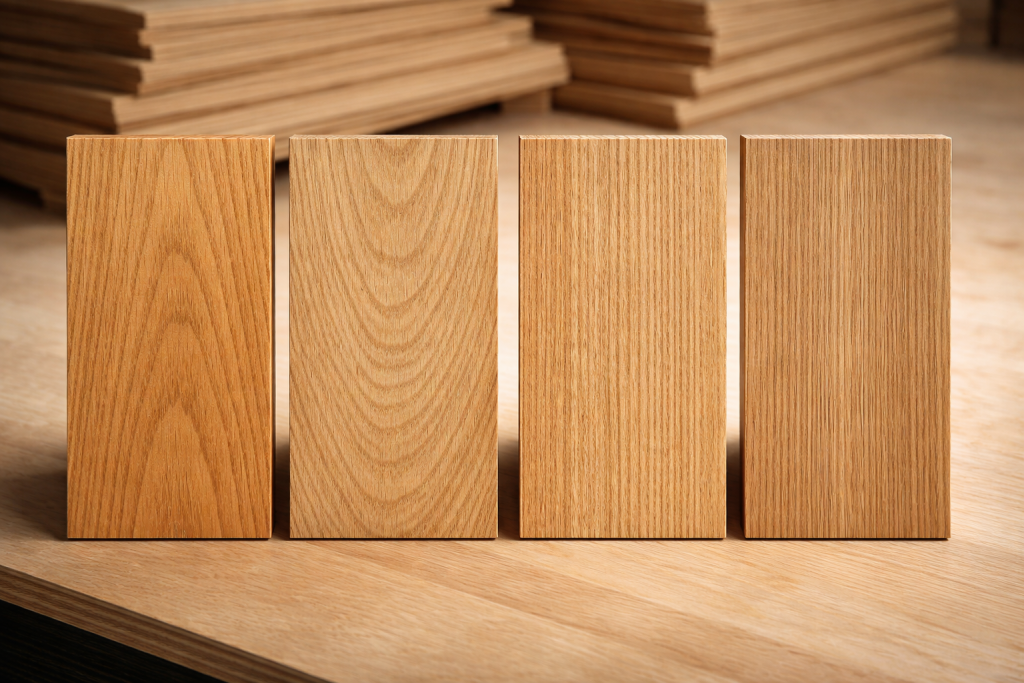

Wood veneer is not just thin wood. How a log is sliced determines grain pattern, yield, cost, and performance in furniture, cabinetry, and architectural millwork. For buyers of wood veneer, understanding cut types is essential to choosing the right material for aesthetics, budget, and application.
Below are the four primary veneer cutting methods, how they are made, and what you can expect from each.
Quick Skim: Veneer Cut Comparison
| Veneer Cut | How It Is Made | Grain Appearance | Yield | Typical Uses | Cost |
|---|---|---|---|---|---|
| Plain Sliced | Flitch sliced horizontally off the top | Cathedral, flowing, high movement | High | Cabinets, wall panels, furniture | Affordable |
| Rotary Cut | Log spun on a lathe against a fixed blade | Wavy, repetitive, consistent | Very high | Plywood, large commercial panels | Most Affordable |
| Quarter Cut | Log quartered, sliced from interior faces | Straight grain with visible flake | Moderate | Doors, furniture, architectural millwork | Mid range |
| Rift Cut | Same method as quarter cut, outer sections only | Tight linear grain, minimal flake | Lower | Modern cabinetry, premium panels | Highest |
Plain Sliced, Flat Cut
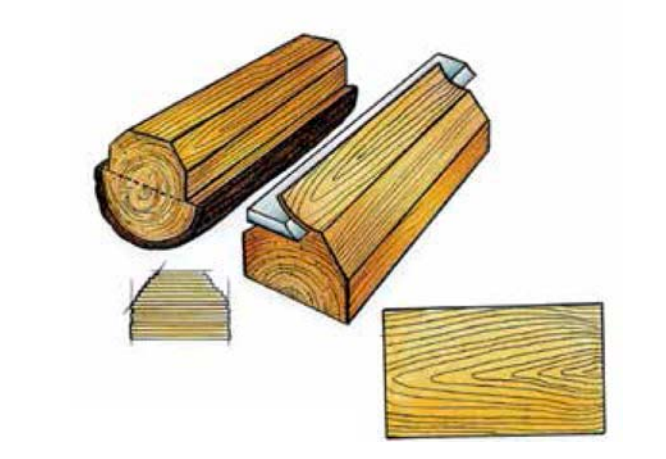
Plain sliced is the most common veneer cut on the market.
The log is first milled into flitches, which are manageable sections of the trunk. These pieces are stacked and sliced horizontally off the top. Each slice reveals a sweeping, arched grain pattern that resembles cathedrals or flames.
This method produces a broad, varied look with dramatic movement across the sheet. Because it follows the natural curvature of the growth rings, plain sliced veneer often shows alternating light and dark areas across the face.
Key Traits:
Most widely available cut
Strong visual movement
Classic, traditional appearance
Efficient use of the log
Plain sliced is ideal for kitchen cabinetry, wall panels, and furniture where warmth and character are desired.
Rotary Cut
Rotary cut veneer is the highest yield method.
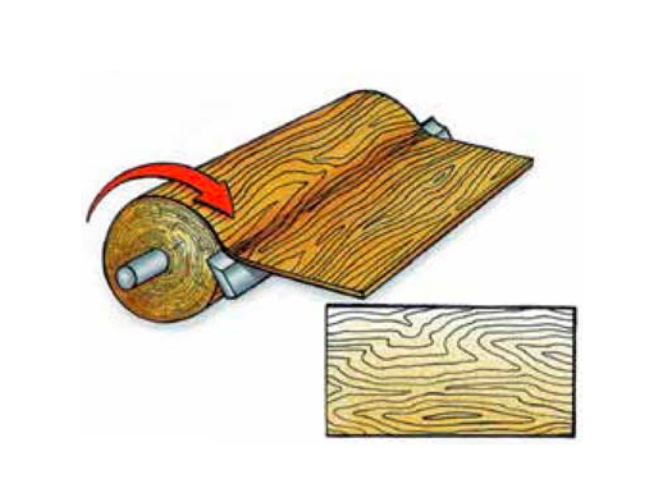
The entire log is placed on a lathe and spun continuously against a fixed blade. As the log rotates, the veneer peels off in one long, unbroken sheet.
This process cuts across the growth rings rather than parallel to them. The result is a flowing, repetitive, wavy pattern that looks very different from other cuts.
Key Traits:
Very high yield
Can produce extremely large continuous sheets
Distinctive, uniform pattern
Common in plywood cores and commercial applications
Rotary cut is frequently used when sheet size and consistency matter more than high-end visual character.
Quarter Cut, Quarter Sawn
Quarter cut veneer starts differently.
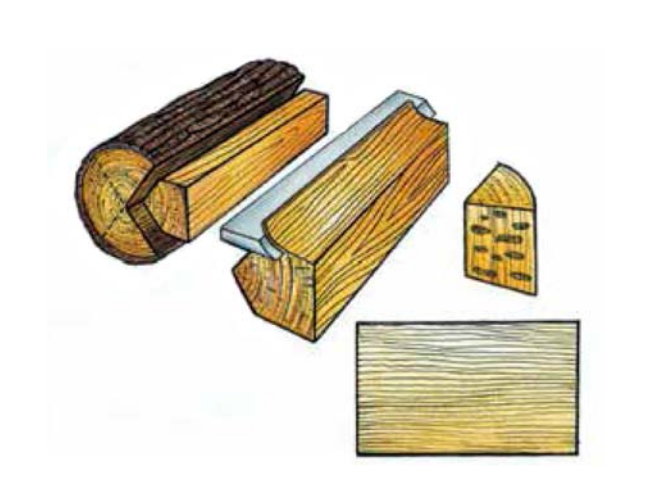
The log is first cut into quarters. Each quarter is then sliced along the interior faces. This approach produces a straight, linear grain pattern rather than sweeping arches.
A defining feature of quarter cut veneer is medullary flake. These are natural ray structures that carry nutrients through the tree. They appear as shimmering, ribbon-like lines across the surface.
Medullary flake is highly visible in white oak and much less noticeable in walnut.
Key Traits:
Linear, orderly grain
Prominent flake in certain species
More stable appearance across the sheet
Uses both heartwood and sapwood
Quarter cut veneer is often chosen for mission, craftsman, and contemporary designs that favor clean lines.
Rift Cut
Rift cut veneer is closely related to quarter cut, but more selective.
It uses the outer portions of the quartered log where medullary flake is minimal or absent. The cutting method is essentially the same, but the specific location within the log is different.
The result is an even tighter, more uniform linear grain with excellent color consistency. Mineral streaks and irregularities are reduced, which gives rift cut a refined, modern look.
Key Traits:
Very straight, tight grain
Minimal flake
Superior color consistency
Higher cost due to lower yield
Rift cut is a top choice for sleek, modern cabinetry, doors, and architectural panels.
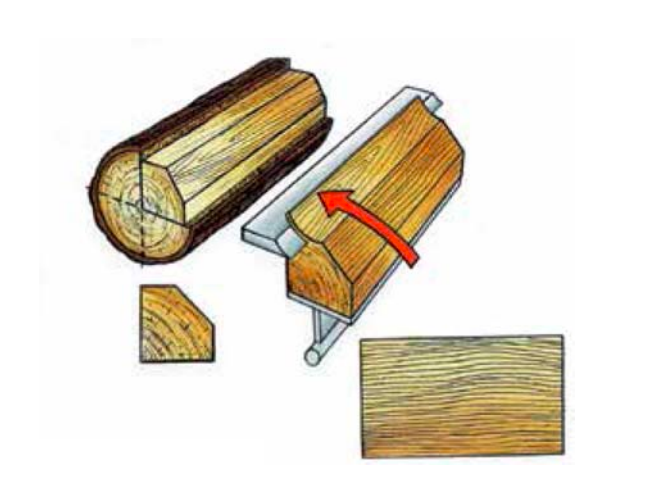
Quarter Cut vs Rift Cut
Many buyers assume these are completely different processes. They are not.
Both quarter cut and rift cut use the same cutting method. The difference is simply which part of the quartered log is used.
Quarter cut includes areas with strong medullary flake. Rift cut avoids those areas to achieve a cleaner, more uniform look.
How to Choose the Right Wood Veneer Cut
Consider three factors before buying.
First, aesthetics. If you want bold movement, choose plain sliced or rotary. If you want straight lines, choose quarter or rift cut.
Second, application. Large commercial panels or plywood often favor rotary cut. High-end cabinetry or millwork tends to favor quarter or rift cut.
Third, budget. Plain sliced and rotary cut are generally more economical. Quarter cut costs more. Rift cut is typically the most expensive due to lower yield.