
The latest 2026 Millwork Equipment Trends Report from Würth Baer Machinery reveals an industry balancing tighter capital budgets with increasing pressure to improve productivity, quality, and flexibility.
For cabinet shops, millwork manufacturers, and woodworking professionals, the message is clear: successful shops are investing strategically instead of standing still.
Here’s a quick look at the trends shaping equipment purchasing and production in 2026.
Quick Skim: Millwork Equipment Trends
| Trend | Why It Matters |
|---|---|
| Equipment spending is slowing | Many shops are delaying purchases despite growing competitive pressure. |
| Capital budgets remain modest | Entry level and mid-tier machinery continue to dominate purchasing decisions. |
| Growing companies keep investing | Higher-performing shops are more likely to modernize operations. |
| Custom production continues to rise | Flexible equipment delivers greater value than ever. |
| Productivity drives automation | Shops automate to produce more with greater consistency. |
| Labor turnover remains a challenge | Equipment and training help offset workforce shortages. |
| Training is a top investment | Skilled operators maximize machine performance. |
| Robotics adoption remains limited | Most shops are focusing on practical automation before robotics. |
| Parts costs continue rising | Long-term maintenance costs deserve more attention during equipment selection. |
| Cabinet tariffs are increasing | Future pricing may encourage earlier investment decisions. |
1. Equipment Spending Has Become More Selective
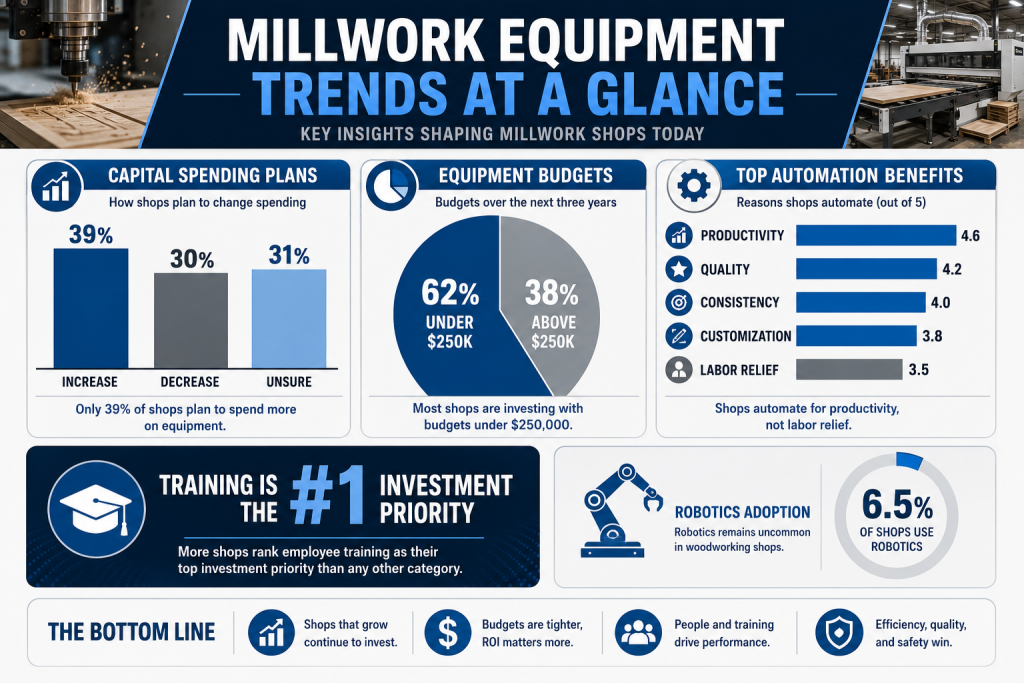
Only 39% of woodworking manufacturers plan to increase equipment spending in 2026, down from 49% just two years ago. Rather than expanding aggressively, many shops are prioritizing investments that produce measurable returns through better productivity and efficiency.
2. Most Capital Budgets Stay Below $250,000
Nearly 62% of woodworking firms expect capital budgets below $250,000 over the next three years. That makes practical, production-focused machinery one of the strongest opportunities for manufacturers looking to improve output without overextending their budgets.
3. Growing Shops Continue Investing
Companies experiencing sales growth are almost twice as likely to increase equipment spending compared to businesses facing declining sales.
The trend suggests that investment often follows confidence, and that growing manufacturers continue improving production capacity even during uncertain markets.
4. Custom Production Is Becoming the Standard
Today, 59% of manufacturers produce mostly made-to-order work, up significantly from 2023.
As customization becomes more common, flexible CNC machinery, nesting software, and faster setup processes become increasingly valuable for maintaining profitability.
5. Productivity Remains the Primary Driver for Automation
When manufacturers invest in automation, the biggest motivation is simple: produce more.
Productivity ranked as the highest reason shops adopt digital manufacturing, followed closely by improved quality and process consistency. Labor shortages remain important, but they are no longer the primary reason companies automate.
6. Workforce Turnover Continues to Shape Equipment Decisions
The U.S. woodworking industry is expected to refill approximately 21,400 positions every year through 2034 due largely to retirements and employee turnover.
As experienced workers leave the industry, equipment that simplifies programming, setup, and operation becomes increasingly valuable.
7. Shops Are Investing in People as Much as Machines
Employee training ranked as the industry’s most common planned investment.
Modern machinery delivers its full value only when operators understand how to use it efficiently. Shops that combine equipment investments with ongoing training are better positioned to improve productivity over the long term.
8. Robotics Are Still an Emerging Technology
Despite growing attention around robotics, only 6.5% of woodworking manufacturers report increasing robotics use.
For most shops, practical automation such as CNC machinery, software integration, and process improvements continues to offer a faster return on investment.
9. Equipment Ownership Costs Continue Rising
The cost of woodworking machinery parts has increased nearly 68% since 2012.
That makes service support, preventative maintenance, and replacement parts an increasingly important consideration when evaluating equipment purchases, not just the initial purchase price.
10. Cabinet Tariffs Could Affect Purchasing Decisions
Current tariffs on certain imported kitchen cabinets and vanities are scheduled to increase from 25% to 50% on January 1, 2027.
Manufacturers evaluating future production capacity may want to consider how changing trade policy could influence demand, pricing, and equipment investment timing.
What These Trends Mean for Woodworking Professionals
The biggest takeaway from the 2026 data is that the industry is becoming more divided.
Growing manufacturers continue investing in productivity, flexible production, and workforce development. Others are delaying modernization, even as labor turnover, maintenance costs, and competitive pressure continue to rise.
Whether you’re evaluating CNC routers, panel processing equipment, edgebanders, sanding systems, or material handling solutions, understanding these trends can help you make more informed purchasing decisions.
For a deeper analysis of the research, statistics, and market outlook behind these findings, read the complete 2026 Millwork Equipment Trends Report from Würth Baer Machinery.
Final Takeaway: Millwork Equipment Trends
Equipment purchasing in 2026 is less about buying the biggest machine and more about investing where it creates measurable gains. Shops that prioritize productivity, flexibility, operator training, and long-term operating costs are positioning themselves to compete more effectively in the years ahead.