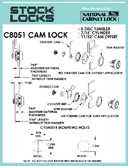
CompX National Disc Tumbler Cam Lock For Cabinets
CompX National disc tumbler cam lock gives drawers and cabinet doors a keyed locking point using a 7/16 inch cylinder sized for typical furniture and casework. The bright nickel finish presents a clean, neutral appearance that fits many shop and office environments. A 3/4 inch mounting hole dimension matches common boring sizes, so the lock fits standard drilling patterns in wood or similar materials. The lock uses 90 degree clockwise rotation, so installers know the exact swing needed to move from locked to unlocked, helping coordinate cam position with the door or drawer strike. The design suits drawers as well as right-hand or left-hand doors, which lets one lock family cover multiple cabinet layouts. This flexibility supports consistent keying and hardware appearance across a whole project, from single cabinets to larger built-ins.
Key Cam Lock Details For Real-World Jobs
- The 7/16 inch cylinder length establishes how far the lock body projects through the front, which helps match the lock to typical cabinet thicknesses without excess protrusion into the interior.
- The 3/4 inch mounting hole requirement defines the boring size, so casework can be drilled accurately in advance using standard shop tooling, streamlining repetitive installations.
- The 90 degree clockwise rotation stop washer limits travel, so the cam only turns a quarter turn, giving predictable handle motion and helping align the locked and unlocked positions with the cam strike.
- The bright nickel description identifies the exterior finish, which allows the lock face to coordinate visually with other bright nickel cabinet hardware in the same room or project.
- Key removable in both locked and unlocked positions allows the operator to withdraw the key after locking or unlocking, which supports workflows where doors may stay open or closed without the key present.
Cam Lock Mounting And Construction Options
The web description specifies that this lock works for drawers and both right-hand and left-hand doors, so a single part can be used across varied cabinet layouts. Cams are described for lipped or overlay construction using a straight cam with a 1-1/2 inch extension, which positions the locking point beyond the door edge on overlay faces. For flush construction, a formed cam with a 1-1/8 inch extension and 11/32 inch offset is described, helping the cam reach behind a flush-front panel. The description notes that for overlay applications the combined thickness of front and frame cannot exceed the cylinder length listed, which ties the hardware selection directly to door and frame build-up. A reference to using the NLC8053 lock with the NLC7014-2C cam for a 3/4 inch front and 3/4 inch frame overlay highlights how cylinder length and cam geometry are matched to heavier overlay sections.
Where This Bright Nickel Cam Lock Fits Best
Using The Cam Lock On Drawers And Doors
The web description states that this cam lock is suited for drawers and both right-hand and left-hand doors, so the same lock body can serve vertical or horizontal fronts. This helps maintain a single key system across mixed casework, reducing part variation during installation. For lipped or overlay constructions, the straight cam with 1-1/2 inch extension reaches past the front edge, which lets the cam engage a strike surface behind an overlay door or drawer face. For flush fronts, the formed cam with 1-1/8 inch extension and 11/32 inch offset is described, positioning the locking point behind the flush panel without requiring extra spacers. By matching the cam style to the cabinet build, installers can align the cam throw with strikes or frame members while keeping the cylinder centered in the front. The 3/4 inch mounting hole specification works with typical boring setups, so these applications integrate easily into production drilling patterns.
Details That Support Consistent Locking Performance
The 90 degree clockwise rotation defined in the description sets a fixed quarter-turn between locked and unlocked, giving predictable handle feel and reducing guesswork when orienting the cam during assembly. The stop washer referenced controls this rotation, helping prevent over-travel that could misalign the cam with the strike. The note that key removal is possible in both locked and unlocked positions affects how users interact with doors, allowing them to leave the key out whether the cabinet is open or secured. Stock keying options are described: KA keyed alike to a specified key number where the master key does not operate, KD keyed different with various lock numbers also not operated by a master key, and KDMKD keyed different and master keyed where a master key will work. These defined keying schemes allow projects to balance shared access and individual security. The mention that REMOVACORE versions are available signals that the same basic lock format can support core-change workflows where required.
Common Questions About CompX National Cam Lock C8051-C415A-14A
What cylinder and hole size does this cam lock use?
The cam lock uses a 7/16 inch cylinder and is designed for a 3/4 inch mounting hole, so boring and front thickness planning can follow those dimensions.
How far does the cam travel between locked and unlocked?
The cam lock is specified with 90 degree clockwise rotation, meaning the cam moves a quarter turn from locked to unlocked using the stop washer.
Can this cam lock be used on both drawers and doors?
The web description states it is for drawers and for right-hand or left-hand doors, so one lock style can serve multiple cabinet front orientations.
What cam options are described for different cabinet constructions?
The description references a straight cam with 1-1/2 inch extension for lipped or overlay construction and a formed cam with 1-1/8 inch extension and 11/32 inch offset for flush construction.
How does key removal work on this CompX National lock?
The web description states the key is removable in both locked and unlocked positions, enabling users to take the key out after either operation.
What stock keying options are described for this cam lock?
Stock keying options listed are KA keyed alike with no master key function, KD keyed different without master key function, and KDMKD keyed different and master keyed.
Select This Cam Lock For Defined Cabinet Builds
This CompX National disc tumbler cam lock with bright nickel description, 7/16 inch cylinder, and 3/4 inch mounting hole ties directly to common cabinet drilling patterns and thicknesses. The specified 90 degree clockwise rotation and stated cam geometries for overlay and flush construction help align the lock choice with your drawer and door build-ups. Defined key removal behavior and the described KA, KD, and KDMKD keying options support planned access control on multi-opening projects. Use these verified dimensions, rotation details, and keying schemes to match this lock to casework where controlled, repeatable locking is required.